
| Transit Type | Coverage in Blue Diamond | Typical Use Case |
|---|---|---|
| Local bus service | None | Not applicable |
| Regional transit connection | None | Not applicable |
| Commuter rail/express bus | None | Not applicable |
| Personal vehicle | Essential | All daily activities |
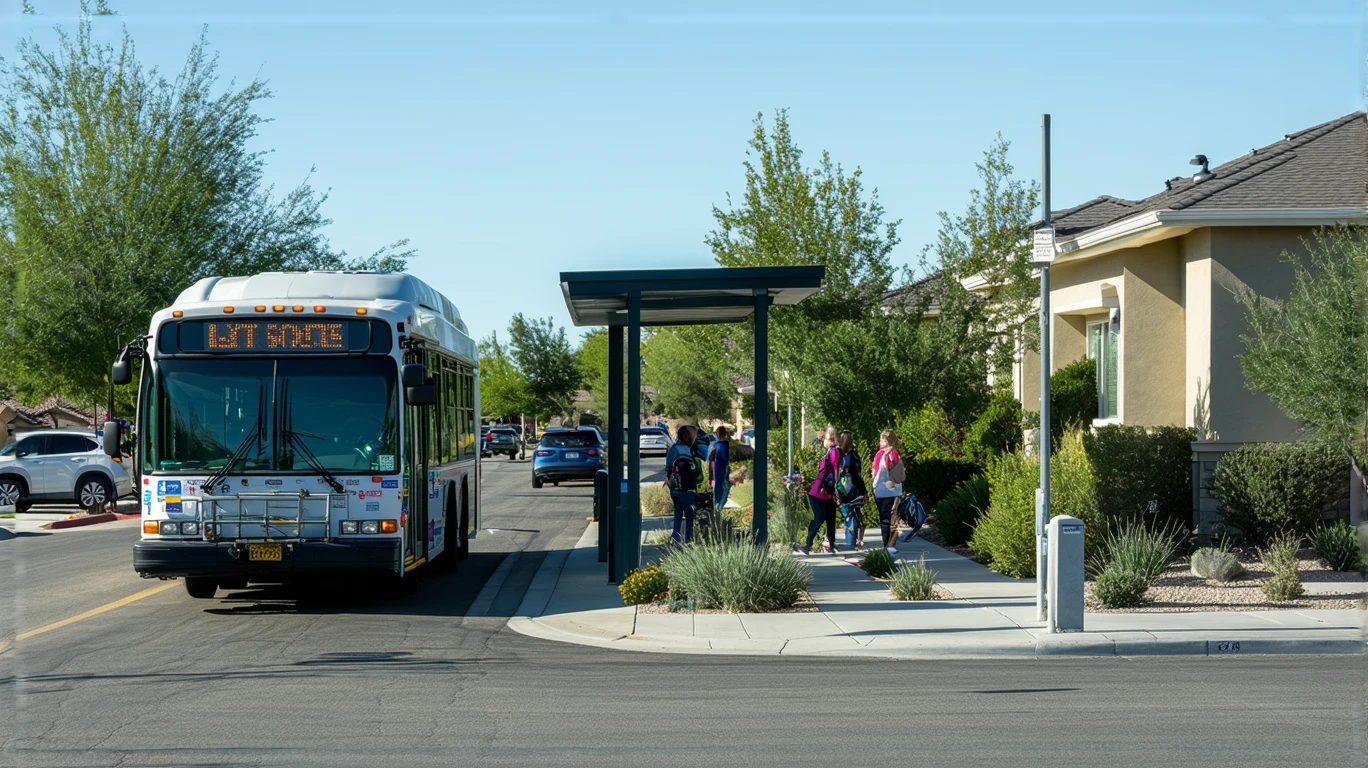
How People Get Around Blue Diamond
Understanding transportation options in Blue Diamond starts with recognizing what kind of place this is: an unincorporated community of fewer than 300 residents, tucked against the eastern edge of the Spring Mountains, roughly 25 miles west of the Las Vegas metro area. There is no downtown, no commercial district, and no local transit service. Every trip—whether for work, groceries, school, or healthcare—requires a personal vehicle.
Newcomers sometimes assume that proximity to a major metro area means access to its infrastructure. That assumption doesn’t hold here. Blue Diamond sits outside the coverage area of the Regional Transportation Commission of Southern Nevada (RTC), the agency that operates public transit throughout much of the Las Vegas Valley. No bus routes extend into Blue Diamond, and no park-and-ride facilities serve the community. The transportation pattern is singular: residents drive.
This isn’t a matter of preference or lifestyle choice. The physical layout of Blue Diamond—low-density residential parcels scattered along a handful of roads, surrounded by federally protected conservation land—makes any form of shared mobility impractical. The community exists as a quiet residential enclave for those who prioritize space, natural surroundings, and separation from urban density, and that geography comes with complete car dependence.
Public Transit Availability in Blue Diamond
Public transit does not serve Blue Diamond. There are no bus stops, no scheduled routes, and no transit infrastructure within or near the community. The nearest RTC bus service operates along the western edges of the Las Vegas metro area, miles to the east, and those routes are designed to connect suburban neighborhoods and commercial corridors within the valley—not to reach isolated communities beyond the urban fringe.
For residents who work in Las Vegas or Henderson, the commute begins and ends in a personal vehicle. There is no practical way to use transit for any portion of the trip. Even if a household were willing to drive partway and transfer to a bus, the time penalty and lack of convenient transfer points make the approach unworkable for daily use.
This is not a gap that’s likely to close. Blue Diamond’s population is too small, its density too low, and its location too remote to justify transit investment. The community’s appeal rests partly on its separation from urban infrastructure, and that separation includes mobility systems.
Driving & Car Dependence Reality
In Blue Diamond, car dependence is absolute. Households need at least one reliable vehicle, and multi-adult households typically require two. There are no walkable errands, no nearby services, and no backup options if a vehicle is unavailable.
The nearest grocery stores, gas stations, and basic services are in the Las Vegas metro area, typically requiring a round trip of 30 to 50 miles depending on the destination. Medical appointments, school activities, and employment all involve similar distances. This means that vehicle reliability, fuel costs, and maintenance are not optional considerations—they are foundational to daily life.
Parking is never an issue. Homes sit on larger parcels with ample space for multiple vehicles, trailers, or recreational equipment. But the tradeoff is clear: every trip is a driving trip, and every household member who needs independent mobility needs their own vehicle.
For retirees or remote workers who don’t commute daily, the driving burden is lighter but still present. Even low-frequency trips—weekly groceries, monthly medical appointments—require planning around vehicle access and fuel. For families with school-age children or multiple jobs, the logistics are more complex, and the cost exposure tied to fuel prices and vehicle upkeep is higher.
Commuting Patterns & Daily Mobility
Most employed residents of Blue Diamond commute into the Las Vegas metro area. The drive typically takes 30 to 45 minutes each way under normal conditions, though traffic along State Route 159 and the western corridors of Las Vegas can add time during peak hours. Commutes are almost always single-occupancy vehicle trips; carpooling is rare given the community’s small size and the variety of destinations workers travel to.
For households with two working adults, coordinating vehicle access and commute timing becomes a daily logistical task. If both adults work in different parts of the metro area, or if one works a non-standard shift, the household often needs two vehicles to function. There’s no fallback—no bus to catch if one car is in the shop, no rideshare service with reliable availability in Blue Diamond.
Remote work changes the equation significantly. Households with one or more remote workers face fewer commute trips and lower fuel exposure, though they still need a vehicle for errands and appointments. The isolation that makes Blue Diamond appealing to some remote workers is the same isolation that makes car ownership non-negotiable.
Who Transit Works For — and Who It Doesn’t
Transit does not work for anyone in Blue Diamond, because transit does not exist here. This is not a matter of coverage gaps, service hours, or route frequency. There is no transit service to evaluate.
Households considering a move to Blue Diamond need to plan for full car dependence from day one. Renters and owners face the same reality. Families with young children, retirees, and single adults all require personal vehicles. There is no household type for whom transit is a viable option, even occasionally.
This makes Blue Diamond a poor fit for anyone who cannot drive, cannot afford vehicle ownership and operation, or prefers not to rely on a car for every trip. It is a strong fit for households that already own vehicles, value space and quiet over convenience, and are comfortable with the time and cost structure that comes with rural living near a metro area.
Transportation Tradeoffs in Blue Diamond
The central tradeoff in Blue Diamond is between mobility cost and housing cost. Homes here tend to be more affordable than comparable properties closer to the Las Vegas core, but that savings comes with higher transportation exposure. Fuel, maintenance, insurance, and vehicle depreciation all weigh more heavily when every trip involves significant mileage.
Driving offers predictability and control. Residents set their own schedules, carry what they need, and aren’t constrained by service hours or coverage limits. But that control comes with responsibility: vehicle breakdowns, fuel price swings, and maintenance needs all fall entirely on the household.
For some households, the tradeoff makes sense. The space, quiet, and proximity to Red Rock Canyon justify the driving burden and the cost. For others—particularly those with tight budgets, limited vehicle access, or a strong preference for walkable neighborhoods—the tradeoff doesn’t pencil out. There’s no middle ground here, no way to reduce car dependence through transit or walkability. Blue Diamond is what it is: a car-dependent community where day-to-day costs are shaped heavily by transportation needs.
FAQs About Transportation in Blue Diamond (2026)
Is public transit usable for daily commuting in Blue Diamond?
No. Public transit does not serve Blue Diamond. There are no bus routes, no transit stops, and no connections to the RTC system that operates in the Las Vegas metro area. Commuting requires a personal vehicle.
Do most people in Blue Diamond rely on a car?
Everyone in Blue Diamond relies on a car. The community has no walkable services, no transit options, and no alternative mobility infrastructure. Vehicle ownership is essential for all daily activities.
Which areas of Blue Diamond are easiest to live in without a car?
None. Blue Diamond is a low-density, unincorporated community with no commercial services, no transit, and no walkable infrastructure. Every part of the community requires a personal vehicle for daily life.
How does commuting in Blue Diamond compare to nearby cities?
Commuting from Blue Diamond involves longer distances and complete car dependence compared to neighborhoods within the Las Vegas metro area. Residents typically drive 25 miles or more each way to reach employment centers, and there are no transit alternatives to reduce that burden.
What happens if a household in Blue Diamond loses access to a vehicle?
Losing vehicle access in Blue Diamond creates immediate hardship. There are no nearby services, no transit options, and no practical way to manage daily errands or commuting without a car. Households need backup plans—whether that’s a second vehicle, access to a rental, or support from neighbors.
How Transportation Fits Into the Cost of Living in Blue Diamond
Transportation in Blue Diamond isn’t just a line item—it’s a structural cost driver that shapes housing decisions, time use, and household logistics. The money spent on fuel, maintenance, and vehicle ownership is directly tied to the community’s geography and isolation. Households that move here trade urban convenience for space and quiet, and that trade includes accepting higher transportation exposure.
For a clearer picture of how transportation costs interact with housing, utilities, and other expenses, the monthly budget guide offers detailed context. But the fundamental point is this: Blue Diamond works for households that are prepared to drive everywhere, every time, and to absorb the costs and logistics that come with that reality. It doesn’t work for households that need or want alternatives.
If you value low density, natural surroundings, and separation from urban infrastructure, and you’re comfortable with the driving that requires, Blue Diamond offers a rare combination of proximity to a major metro area and genuine rural character. If you need walkability, transit access, or the ability to reduce car dependence, this isn’t the place.
How this article was built: This article draws on publicly available information about Blue Diamond’s geography, population, and infrastructure, as well as the known service boundaries of regional transit systems. No numeric commute data, fare information, or transit schedules were available for Blue Diamond, as no transit service operates in the community. All conclusions reflect the structural realities of an unincorporated, low-density area outside urban transit coverage.
—