
Do you really need a car to live in Edmonds? The answer depends less on the city as a whole and more on where you land within it—and how you structure your daily life. Edmonds sits along the Puget Sound with a mix of walkable downtown pockets and residential neighborhoods that stretch inland, creating a transportation landscape that rewards proximity but still leans on driving for many households. Public transit exists and plays a meaningful role, especially for commuters heading into Seattle or along regional corridors, but it doesn’t eliminate the need for a vehicle for most residents. Understanding transportation options in Edmonds means recognizing that this is a place where rail access, walkable streets, and car dependence coexist—sometimes within the same zip code.
What newcomers often misunderstand is that Edmonds isn’t uniformly car-dependent, nor is it a transit-first environment. The city’s layout creates distinct mobility zones: areas near the waterfront and downtown core support walking and transit use, while neighborhoods farther from these hubs require more planning and flexibility if you’re trying to avoid driving. The commute reality here reflects that tension. With an average commute time of 28 minutes and 47.9% of workers facing long commutes, many Edmonds residents are traveling well beyond the city limits for work—a pattern that tends to favor car ownership even when local errands might not require it.
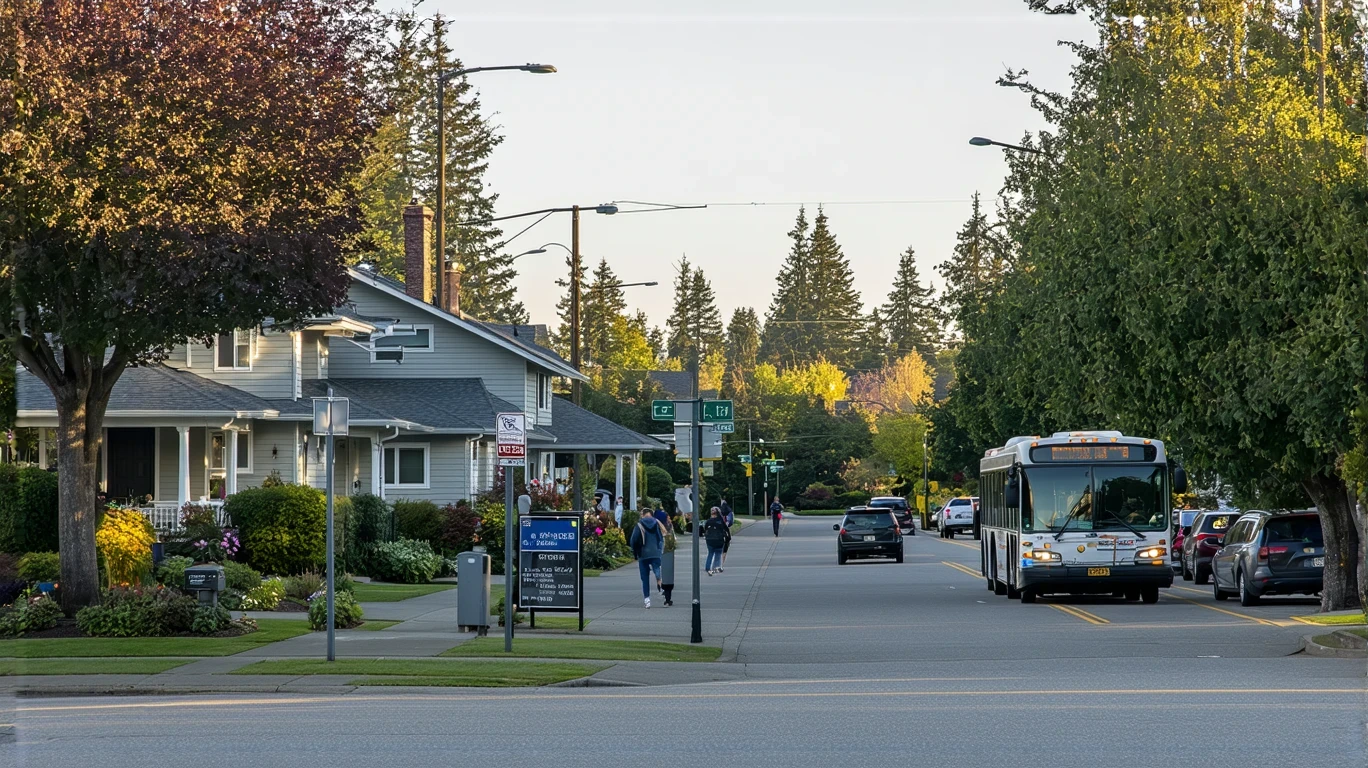
Public Transit Availability in Edmonds
Public transit in Edmonds often centers around systems such as Sound Transit and Community Transit, with rail service providing a direct link to Seattle and other parts of the region. The presence of rail is significant—it offers a reliable, predictable option for commuters who work along the line and live within reasonable distance of a station. For those households, transit isn’t just a backup; it’s a structuring force that shapes housing decisions, work schedules, and daily routines.
But transit coverage isn’t uniform. Rail serves specific corridors, and bus service fills in gaps, but the further you move from downtown or station areas, the less practical transit becomes for everyday use. Late-night service is limited, weekend frequency can be sparse, and multi-stop errands—picking up groceries, dropping off kids, running to the hardware store—become logistically difficult without a car. Transit works best here for single-destination commutes during peak hours, particularly for workers heading into Seattle or Lynnwood. It works less well for families managing complex schedules, for shift workers outside traditional hours, or for residents in quieter residential streets where the nearest bus stop might be a 15-minute walk away.
Driving & Car Dependence Reality
For many Edmonds residents, driving remains the default. The city’s layout—residential neighborhoods radiating out from a compact downtown core—means that while you can walk to coffee or dinner in certain pockets, reaching a grocery store, getting to a doctor’s appointment, or commuting to a job outside the immediate area usually requires a car. Parking is generally available and less constrained than in denser urban centers, which removes one friction point but reinforces car reliance as the path of least resistance.
Car dependence here isn’t about sprawl in the traditional sense; Edmonds is relatively compact. It’s about connectivity. The street grid supports driving efficiently, and the regional commute pattern—nearly half of workers traveling long distances—suggests that many residents are navigating a geography that extends well beyond the city limits. That creates a transportation structure where even households that could theoretically live car-free in their immediate neighborhood often choose not to, because the flexibility and reach of a vehicle outweigh the cost and hassle of ownership.
Commuting Patterns & Daily Mobility
Commuting in Edmonds tends to follow one of two patterns: either you’re heading into Seattle or another regional employment center via transit or highway, or you’re driving locally or to nearby suburbs for work. The 28-minute average commute time suggests that most workers aren’t traveling extreme distances, but the 47.9% long-commute figure tells a different story—it indicates that a substantial portion of residents are absorbing significant travel time, likely by car, to reach jobs that aren’t accessible by a quick bus ride or train trip.
For single-job commuters working standard hours along a transit line, the calculus is straightforward: rail service makes car-free or car-light living feasible. For everyone else—parents managing school drop-offs, workers with irregular schedules, households running errands across multiple stops—the reality is more complex. Daily mobility here often involves layering: walking for some tasks, driving for others, and occasionally using transit when it aligns with timing and destination. Only 11.0% of workers in Edmonds work from home, meaning the vast majority are making some kind of regular commute, and the infrastructure reflects that.
Who Transit Works For — and Who It Doesn’t
Transit in Edmonds works best for renters and homeowners who live near rail stations or along well-served bus corridors, particularly those commuting into Seattle for work. If your job, your home, and your daily errands all fall within a narrow geographic band that aligns with transit routes, you can build a life with minimal or no driving. That’s a real option here, but it’s not the default experience.
Transit works less well for families with children, especially those managing school schedules, after-school activities, and weekend logistics. It also falls short for workers in industries or job sites that aren’t clustered along transit lines—healthcare, trades, retail, and service jobs often require travel to locations that aren’t easily reached without a car. Households in peripheral neighborhoods, even if they’re technically within Edmonds city limits, face longer walks to transit stops and less frequent service, which erodes the practicality of relying on buses or trains for daily needs.
The distinction isn’t about income or preference; it’s about spatial fit. If your life happens along the transit spine, it works. If it doesn’t, driving becomes necessary, not optional.
Transportation Tradeoffs in Edmonds
Choosing between transit and driving in Edmonds isn’t a binary decision—it’s a tradeoff between control and cost, predictability and flexibility. Transit offers lower direct costs (no fuel, no parking fees, no maintenance), but it imposes constraints: fixed schedules, limited coverage, and reduced spontaneity. Driving offers freedom and reach, but it comes with exposure to fuel price swings—currently $4.15 per gallon—along with insurance, registration, and upkeep.
For commuters, transit provides predictability. A train schedule is a train schedule, and traffic jams don’t change it. For households managing multiple destinations or irregular hours, driving provides adaptability. The tradeoff isn’t about which is cheaper in the abstract; it’s about which aligns with how your household actually functions day to day. Edmonds rewards proximity to transit with real mobility options, but it doesn’t penalize car ownership the way denser, more congested cities do. That middle ground makes it easier to own a car here, but harder to justify going entirely without one unless your life is tightly organized around transit access.
FAQs About Transportation in Edmonds (2026)
Is public transit usable for daily commuting in Edmonds?
Yes, especially if you’re commuting into Seattle or along regional rail lines. Rail service provides a reliable option for workers whose jobs align with transit routes. For local trips or off-peak travel, transit becomes less practical, and many residents supplement with driving.
Do most people in Edmonds rely on a car?
Yes. While transit exists and serves commuters well in certain corridors, the majority of residents drive regularly. The commute data—47.9% facing long commutes—suggests that many workers are traveling distances or to destinations that require a vehicle.
Which areas of Edmonds are easiest to live in without a car?
Neighborhoods near downtown and close to rail stations offer the most car-free or car-light viability. Walkable streets, higher errand density, and direct transit access make it possible to manage daily life with less driving. Peripheral residential areas require more planning and typically more reliance on a vehicle.
How does commuting in Edmonds compare to nearby cities?
Edmonds sits in a regional commuting pattern where many residents travel into Seattle or other employment centers. The 28-minute average commute is moderate, but the high percentage of long commutes suggests that Edmonds functions as a residential base for workers whose jobs are elsewhere. Compared to denser urban centers, commuting here involves more driving; compared to more isolated suburbs, it offers better transit access.
Can you get by without a car if you work from home in Edmonds?
Potentially, especially if you live near walkable corridors or transit stops. Working from home removes the commute variable, so the question becomes whether you can manage groceries, errands, and social life without driving. In downtown or near-downtown areas, that’s feasible. In quieter residential neighborhoods, it’s more challenging and may require regular use of rideshare or delivery services.
How Transportation Fits Into the Cost of Living in Edmonds
Transportation in Edmonds isn’t just a line item—it’s a structural factor that shapes where you can live, how much time you spend commuting, and how much flexibility you have in daily life. Households that can align their routines with transit access gain both cost savings and predictability. Those who can’t face ongoing exposure to fuel prices, vehicle costs, and the time burden of driving.
The real cost isn’t just what you spend on gas or transit fares; it’s how transportation limits or expands your options. Living near a rail station might allow you to rent a smaller, more affordable home because you’re not paying for parking or a second car. Living farther out might require vehicle ownership, but it also might mean access to larger homes or quieter streets. The tradeoff is always between access and expense, and in Edmonds, both sides of that equation are in play.
For a fuller picture of how transportation costs interact with housing, utilities, and other expenses, see Your Monthly Budget in Edmonds: Where It Breaks. Understanding where money goes helps clarify whether proximity to transit or car ownership makes more sense for your household. The goal isn’t to eliminate transportation costs—it’s to structure them in a way that supports the life you’re trying to build here.
How this article was built: In addition to public economic data, this article incorporates location-based experiential signals derived from anonymized geographic patterns—such as access density, walkability, and land-use mix—to reflect how day-to-day living actually feels in Edmonds, WA.