
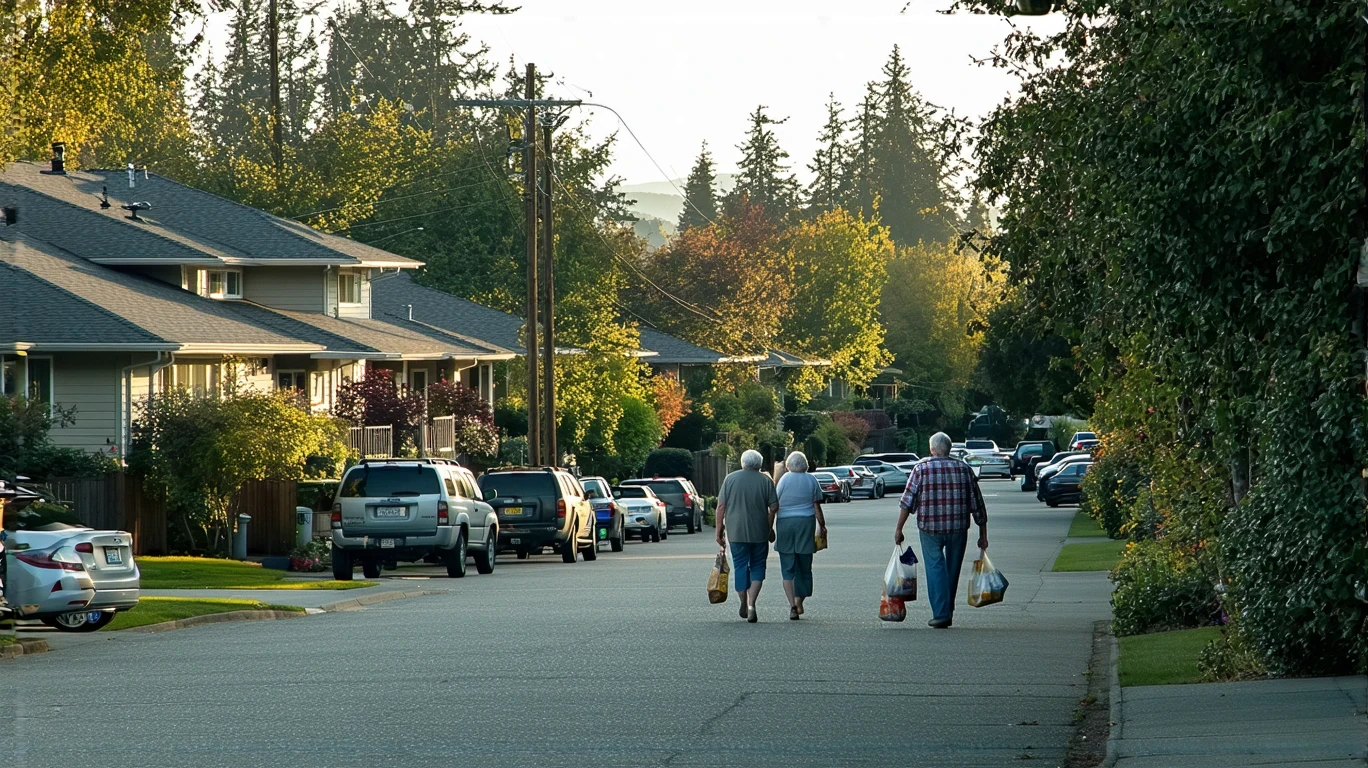
How Grocery Costs Feel in Edmonds
Grocery prices in Edmonds sit noticeably above the national baseline, reflecting the broader cost structure of the Seattle metro area. With a regional price parity index of 113—meaning prices run roughly 13% higher than the U.S. average—food shopping here requires more budget allocation than in many other parts of the country. For households earning near or above Edmonds’ median income of $110,057 per year, this premium feels manageable, absorbed into a larger cost-of-living picture dominated by housing. But for single earners, young families stretching toward homeownership, or retirees on fixed incomes, grocery costs represent a more persistent pressure point—one that demands attention to store choice, meal planning, and seasonal buying habits.
The experience of grocery shopping in Edmonds varies significantly depending on household composition. A two-person household with dual incomes may notice the higher prices but rarely feel constrained by them, especially when prioritizing convenience or organic options. Families with children, however, face compounding pressure: more mouths to feed, more frequent trips, and less flexibility to absorb week-to-week price swings. Singles living alone encounter the sharpest per-person cost burden, as smaller package sizes and less opportunity for bulk purchasing amplify the regional price premium. Unlike housing or transportation—where costs scale predictably with household size—grocery spending grows unevenly, making food one of the few expense categories where larger households can achieve better per-person efficiency if they shop strategically.
What makes grocery costs in Edmonds distinct isn’t just the price level—it’s the interaction between regional pricing, local income distribution, and the structure of food retail access. Food establishments are abundant throughout the city, but grocery stores themselves cluster along specific commercial corridors rather than spreading evenly across neighborhoods. This concentration means that while residents have access to a range of store tiers—from discount chains to premium natural grocers—the convenience of comparison shopping or switching between stores depends heavily on where you live and how much time you’re willing to invest. For households already managing tight budgets, that friction matters: the difference between a quick stop at the nearest store and a planned trip to a lower-cost option can shift weekly spending by 15% or more, even before considering brand or product choices.
Grocery Price Signals (Illustrative)
These prices illustrate how staple items tend to compare locally—not a full shopping list. They reflect the regional price environment in Edmonds and provide context for understanding relative cost positioning across common grocery categories. Actual checkout totals depend on brand preference, store tier, quantity purchased, and whether items are on sale, but these figures offer a grounded reference point for evaluating food cost pressure.
| Item | Price |
|---|---|
| Bread | $2.08/lb |
| Cheese | $5.47/lb |
| Chicken | $2.31/lb |
| Eggs | $2.91/dozen |
| Ground Beef | $7.63/lb |
| Milk | $4.63/half-gallon |
| Rice | $1.20/lb |
Protein costs—particularly ground beef—stand out as a category where Edmonds’ regional premium becomes most visible. At over $7.60 per pound, beef represents a significant line item for families building meals around meat-based dinners. Chicken offers a more moderate option, but even poultry prices reflect the broader upward pressure. Dairy and eggs, while not extreme, add up quickly for households with children or anyone cooking from scratch regularly. Shelf-stable staples like rice remain relatively affordable, providing a foundation for budget-conscious meal planning, but they don’t offset the cumulative impact of higher prices across fresh and perishable categories.
These item-level prices also reveal why store tier matters so much in Edmonds. A household shopping exclusively at a premium natural grocer might see cheese, milk, and eggs priced 20–30% higher than the figures above, while a discount chain could bring several of these items below the listed range. The prices shown here represent a middle-ground snapshot, but the lived experience of grocery costs depends heavily on which stores a household can access conveniently and how much time they’re willing to invest in seeking out lower-cost options. For families managing day-to-day costs, that choice isn’t just about preference—it’s a meaningful lever for controlling one of the few expense categories where behavior and planning can produce measurable relief.
Store Choice & Price Sensitivity
Grocery price pressure in Edmonds varies dramatically by store tier, and understanding that variation is essential for managing food costs effectively. Discount-tier stores—typically no-frills chains focused on private-label products and high-volume turnover—offer the most accessible entry point for budget-conscious households. Shopping at this tier can reduce weekly grocery spending by 15–25% compared to mid-tier supermarkets, particularly for staples like bread, rice, eggs, and canned goods. These stores sacrifice selection breadth and prepared food options in exchange for lower prices, which works well for households willing to plan meals around what’s available rather than what’s preferred. For single earners or families stretching income toward housing costs, discount-tier shopping isn’t just a preference—it’s often a necessity.
Mid-tier grocery stores dominate the Edmonds landscape and represent the default shopping experience for most households. These are the familiar regional and national supermarket chains offering a balance of selection, convenience, and moderate pricing. They stock both name-brand and store-brand options, maintain full-service deli and bakery sections, and typically anchor the commercial corridors where grocery density is highest. Prices here align closely with the illustrative figures shown earlier, and for households earning near or above the city’s median income, mid-tier stores provide enough variety and quality to meet weekly needs without requiring significant price comparison or travel. The tradeoff is straightforward: you pay a modest premium for convenience, selection, and the ability to complete a full shopping trip in one location.
Premium-tier grocers—natural food stores, specialty markets, and upscale chains—cater to households prioritizing organic produce, sustainably sourced proteins, and prepared meal options. Prices at this tier can run 25–40% higher than mid-tier stores, with the gap widening significantly in categories like cheese, meat, and packaged snacks. For high-earning couples or smaller households with discretionary income, premium stores offer a shopping experience that aligns with lifestyle preferences around food quality and sourcing transparency. But for families managing tighter budgets, even occasional trips to premium stores can destabilize weekly spending. The key insight here is that Edmonds supports all three tiers, but access isn’t evenly distributed: premium options cluster near higher-income neighborhoods, while discount stores often require longer drives, creating a geography of grocery costs that mirrors the city’s broader income stratification.
What Drives Grocery Pressure Here
The primary driver of grocery cost pressure in Edmonds is the regional price environment, anchored by the 13% premium reflected in the area’s price parity index. This isn’t a quirk of local retail—it’s a structural feature of the Seattle metro economy, where higher wages, elevated real estate costs for commercial space, and regional distribution expenses all flow through to consumer prices. Grocery stores in Edmonds face the same cost base as retailers throughout the metro area, and those costs get passed along in the form of higher shelf prices. For households relocating from lower-cost regions, this adjustment can feel abrupt: the same cart of groceries that cost $120 elsewhere might run $135–$145 here, even at comparable store tiers.
Income distribution within Edmonds creates a second layer of pressure differentiation. With a median household income above $110,000, many residents absorb grocery costs without significant lifestyle compromise. But that median masks considerable variation: younger households, single earners, and service-industry workers often earn well below that threshold, and for them, the regional price premium translates into genuine budget strain. Grocery costs don’t scale linearly with income—a household earning 60% of the median doesn’t simply allocate 60% of a higher-income household’s grocery budget. Instead, they face the same per-unit prices but with far less discretionary cushion, forcing harder tradeoffs between food quality, variety, and spending in other categories.
Household size amplifies these dynamics in ways that aren’t immediately obvious. A single adult might spend less in absolute terms than a family of four, but their per-person costs are often higher due to smaller package sizes, less opportunity for bulk purchasing, and the fixed overhead of maintaining a stocked kitchen. Families with children, meanwhile, face relentless volume pressure: more meals, more snacks, more waste, and less flexibility to skip trips or stretch ingredients. The corridor-clustered grocery access pattern in Edmonds adds friction here, because larger households benefit most from store choice and price comparison, but they’re also the least able to make frequent trips to multiple locations. The result is a system where the households facing the greatest grocery pressure are also the least positioned to optimize around it.
Practical Ways People Manage Grocery Costs
The most effective strategy for managing grocery costs in Edmonds is deliberate store-tier selection combined with consistent shopping habits. Households that commit to discount-tier stores for staples—rice, beans, pasta, canned goods, frozen vegetables—and reserve mid-tier trips for fresh produce and proteins can reduce overall spending without sacrificing meal quality. This approach requires planning and a willingness to shop at multiple locations, but it leverages the price variation between tiers in a way that compounds over weeks and months. The key is consistency: occasional discount shopping doesn’t move the needle, but making it the default for 60–70% of purchases does.
Meal planning and batch cooking offer another high-impact lever, particularly for families and dual-income households where time pressure often drives convenience purchases. Cooking larger quantities on weekends and freezing portions reduces both per-meal costs and the temptation to fill gaps with takeout or prepared foods. It also allows households to buy proteins and produce in larger quantities when prices dip, smoothing out the week-to-week volatility that makes grocery budgets feel unpredictable. This strategy works best when paired with a realistic assessment of household cooking capacity—overambitious meal plans that don’t get executed just shift waste from the store to the home.
Seasonal buying and flexibility around produce choices provide subtler but meaningful savings. Households that build meals around what’s in season rather than what’s on a fixed shopping list benefit from lower prices and better quality. This doesn’t require expertise—it just means noticing when berries, greens, or root vegetables are abundant and adjusting weekly menus accordingly. Similarly, being flexible about protein sources—choosing chicken thighs over breasts, or pork shoulder over beef—allows households to respond to price signals without feeling deprived. These adjustments don’t produce dramatic week-over-week savings, but they reduce cumulative spending and make grocery costs feel more manageable over time.
Groceries vs Eating Out (Directional)
The tradeoff between cooking at home and eating out in Edmonds isn’t purely financial—it’s a question of time, convenience, and how much control a household wants over food costs. Cooking at home consistently offers the lowest per-meal cost, especially when households shop strategically and plan around leftovers. But the time investment is real: shopping, prep, cooking, and cleanup can easily consume 60–90 minutes per meal, and for dual-income households or parents managing children’s schedules, that time often feels scarce. Eating out eliminates that labor but introduces a significant cost premium, particularly in a region where restaurant prices reflect the same elevated wage and real estate costs that drive grocery prices higher.
For households trying to balance these pressures, the most sustainable approach is usually a hybrid: cooking the majority of meals at home while reserving dining out for specific occasions or high-stress weeks. The key is avoiding the middle ground where frequent takeout or delivery orders erode the savings from home cooking without delivering the convenience or experience that makes dining out feel worthwhile. Families that cook five or six dinners per week and eat out once typically find a rhythm that keeps grocery costs predictable while preserving some flexibility. Singles and couples without children often have more latitude here, but even for them, frequent restaurant meals can quietly consume 15–20% of monthly income if left unchecked.
The decision also depends on what kind of dining out we’re discussing. Quick-service meals—fast casual, counter-service spots—cost less than sit-down restaurants but still run two to three times the per-meal cost of home cooking. For households using these options as a convenience fallback rather than a planned treat, the cumulative impact can be significant. The households that manage this tradeoff most effectively are those who treat dining out as a deliberate budget category with a fixed monthly allocation, rather than a variable expense that flexes based on how busy the week feels. That discipline doesn’t eliminate the tradeoff, but it prevents dining costs from quietly displacing grocery savings.
FAQs About Grocery Costs in Edmonds (2026)
Is it cheaper to shop in bulk in Edmonds? Bulk purchasing can reduce per-unit costs significantly, especially for shelf-stable staples and household goods, but it requires upfront capital and storage space. Warehouse club memberships pay off most clearly for larger households that can consume bulk quantities before spoilage becomes an issue.
Which stores in Edmonds are best for low prices? Discount-tier grocery chains consistently offer the lowest prices on staples and private-label products, though selection is narrower than mid-tier supermarkets. Households willing to shop at multiple stores—discount for basics, mid-tier for fresh items—typically achieve the best balance of cost and quality.
How much more do organic items cost in Edmonds? Organic produce, dairy, and proteins typically carry a premium of 20–50% over conventional options, with the gap widening at premium-tier stores. For budget-conscious households, prioritizing organic purchases for high-pesticide-residue items while buying conventional versions of lower-risk produce can reduce costs without fully abandoning organic preferences.
How do grocery costs for two adults in Edmonds tend to compare to nearby cities? Grocery prices across the Seattle metro area remain fairly consistent due to shared distribution networks and regional wage structures. Driving to neighboring cities rarely produces meaningful savings unless you’re accessing a different store tier altogether, and the fuel and time costs often offset any price advantage.
How do households in Edmonds think about grocery spending when cooking at home? Most households treat grocery costs as one of the few expense categories where planning and behavior can produce measurable relief. Unlike housing or transportation, where costs are largely fixed, food spending responds directly to store choice, meal planning, and willingness to adjust habits—making it a key lever for households managing where money goes each month.
How Groceries Fit Into the Cost of Living in Edmonds
Grocery costs in Edmonds occupy a distinct position within the city’s broader cost structure. Unlike housing—which dominates household budgets and offers limited flexibility once a lease is signed or a mortgage is locked—grocery spending remains one of the few categories where month-to-month behavior can shift outcomes. That responsiveness makes food costs feel more manageable for some households, but it also places a persistent planning burden on those already stretched thin by housing pressure and transportation expenses. For families earning near the median income, groceries represent a noticeable but not overwhelming share of monthly spending. For single earners or households with children, food costs can quietly consume 12–15% of take-home income, especially when convenience purchases and dining out creep into the mix.
The regional price premium that defines grocery costs in Edmonds doesn’t exist in isolation—it’s part of the same economic environment that drives up housing, utilities, and services. Households relocating here from lower-cost regions often notice grocery prices first, because food shopping happens weekly and the comparison is immediate. But over time, it’s the cumulative interaction between elevated grocery costs, high rent or mortgage payments, and above-average transportation expenses that defines financial pressure. Groceries alone don’t make or break affordability in Edmonds, but they contribute to a cost structure where even high-earning households feel less financial cushion than their income might suggest.
For a complete picture of how grocery costs fit into monthly spending—and how they interact with housing, transportation, and utilities—readers should consult Your Monthly Budget in Edmonds, which breaks down the full expense landscape and explains where different household types feel the most pressure. Understanding grocery costs in isolation provides useful tactical guidance, but the real question for most households is how food spending fits alongside everything else. The answer depends on income, household size, and how much flexibility exists in other categories, but the underlying reality is consistent: in Edmonds, grocery costs are higher than much of the country, and managing them well requires deliberate choices about store tier, meal planning, and how often convenience replaces strategy.
How this article was built: In addition to public economic data, this article incorporates location-based experiential signals derived from anonymized geographic patterns—such as access density, walkability, and land-use mix—to reflect how day-to-day living actually feels in Edmonds, WA.