
Transportation options in Fontana reflect a city caught between its suburban bones and emerging urban pockets. Most residents drive—there’s no getting around that reality—but the infrastructure tells a more layered story than the typical Inland Empire car-first suburb. Rail service exists here, pedestrian density spikes in specific corridors, and grocery access is strong enough that not every errand requires a long drive. The question isn’t whether you can live here without a car—it’s whether your daily destinations align with the places where transit and walkability actually function.
What newcomers often misunderstand is that Fontana’s transportation reality varies dramatically by neighborhood. The city’s development pattern created distinct zones: some areas feature higher building density, mixed-use corridors, and genuine pedestrian infrastructure, while others remain classic low-rise suburban sprawl where sidewalks lead nowhere useful. Your mobility experience depends almost entirely on where you land within that patchwork.
How People Get Around Fontana
The dominant pattern is driving. With 33-minute average commutes and nearly half of all workers facing long-distance travel, most households structure their lives around car ownership. Only 17.4% work from home, meaning the vast majority leave the house for employment—and given Fontana’s position within the broader Inland Empire economy, many of those jobs sit in neighboring cities or farther into Los Angeles and Orange counties.
But daily life isn’t just about the commute. The city’s layout creates different friction points depending on what you’re doing. Running errands? Food and grocery establishments are broadly accessible throughout Fontana, with density exceeding typical suburban thresholds. That means quick trips for milk, prescriptions, or takeout rarely require long drives or freeway access. Commuting to work? That’s where the car becomes non-negotiable for most residents, especially those whose jobs lie outside the city.
Pedestrian infrastructure exists in pockets—genuine pockets with high pedestrian-to-road ratios—but these areas don’t blanket the city. If you live near one of these corridors, walking to nearby shops or transit stops becomes practical. If you don’t, you’re driving to reach anything beyond your immediate block.
Public Transit Availability in Fontana
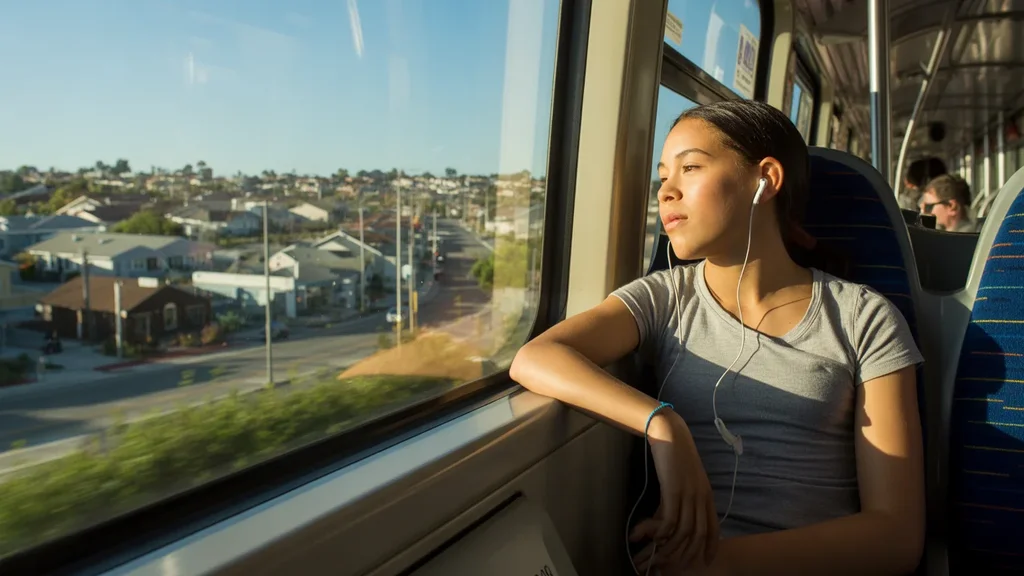
Public transit in Fontana often centers around systems such as Metrolink and Omnitrans, though coverage and utility vary significantly by location. Rail service exists within the city, providing a real alternative for residents whose destinations align with station locations and service patterns. For someone commuting into downtown Los Angeles or other rail-served job centers, proximity to a Fontana station changes the transportation calculus entirely.
Bus service operates throughout the area, but its practical role tilts toward supplemental rather than primary transportation for most households. Transit works best in the denser, mixed-use corridors where destinations cluster within walking distance of stops. In lower-density residential zones—where homes spread out and commercial services thin—transit becomes harder to rely on for anything beyond occasional trips.
The gaps are predictable: late-night service is limited, coverage doesn’t extend uniformly across all neighborhoods, and multi-stop errands (picking up kids, groceries, and dry cleaning in one loop) remain difficult without a car. Transit serves specific travel patterns well—linear commutes along established corridors, trips to regional destinations—but it doesn’t replicate the flexibility of driving for complex household logistics.
Driving & Car Dependence Reality
Car ownership in Fontana isn’t about preference; it’s about structure. The city’s geography, job distribution, and development history all point toward driving as the default. Parking is abundant and rarely a friction point—most housing includes dedicated spaces, and commercial areas provide lots rather than meters and garages.
For families, the car dependence intensifies. School drop-offs, activity shuttles, and weekend errands all assume vehicle access. Even in neighborhoods with decent pedestrian infrastructure, the distances between home, school, work, and shopping often exceed what’s practical on foot or via transit, especially when managing multiple stops or tight schedules.
The tradeoff is predictability. Driving gives you control over timing, routing, and cargo capacity. You’re not waiting for connections or adjusting plans around service windows. But that control comes with exposure: fuel costs at $4.81 per gallon, maintenance, insurance, and the time cost of those 33-minute average commutes. The question isn’t whether driving is necessary—it usually is—but how much of your day it consumes.
Commuting Patterns & Daily Mobility
Commuting in Fontana often means leaving Fontana. The 46.1% of workers facing long commutes suggests a significant portion of the labor force travels well beyond city limits for employment. That’s the Inland Empire pattern: housing affordability draws residents, but job concentrations sit elsewhere—LA, Orange County, San Bernardino, Riverside.
For those commuting into regional job centers, rail access becomes the key variable. If your workplace sits near a Metrolink-served station and you live near a Fontana station, you’ve unlocked a viable alternative to daily freeway driving. If either end of that equation doesn’t line up, you’re back in the car.
Single-job commutes are one thing; multi-stop days are another. Households managing daycare pickups, medical appointments, or errands between work shifts find transit far less practical. The flexibility to reroute, to handle an unexpected stop, to carry bulky items—that’s where car dependency becomes non-negotiable regardless of transit availability.
Who Transit Works For — and Who It Doesn’t
Transit in Fontana works for specific household types in specific situations. A single professional commuting to a rail-accessible job in downtown LA, living near a Fontana station, can build a functional car-free or car-light lifestyle. A renter in one of the denser, mixed-use corridors with walkable grocery access and flexible work hours might manage with occasional rideshares supplementing bus service.
It doesn’t work well for families with school-age children, especially those in neighborhoods far from transit corridors. It doesn’t work for shift workers whose hours fall outside service windows. It doesn’t work for households where both adults commute in different directions, or where job locations change frequently.
Renters in core areas have more flexibility to test transit viability before committing to car ownership. Homeowners in peripheral neighborhoods, by contrast, are typically locked into car dependence by location—proximity to good schools or larger lots often means distance from transit infrastructure.
Transportation Tradeoffs in Fontana
The choice between transit and driving in Fontana isn’t really a choice for most residents—it’s a question of whether your specific situation allows transit to cover enough trips to matter. Transit offers lower direct costs and eliminates parking concerns, but it requires schedule flexibility and limits spontaneity. Driving offers control and speed but locks you into fuel exposure, maintenance cycles, and the mental load of traffic navigation.
For households near rail stations with compatible commute destinations, transit can handle the biggest single transportation task—the work commute—while a car covers everything else. That’s a hybrid model, not car-free living, but it reduces weekly driving substantially compared to all-car households.
For everyone else, the tradeoff is less about transit versus driving and more about how to structure life around car dependence: proximity to work, commute timing to avoid peak congestion, and housing location that minimizes daily drive distances even if it doesn’t eliminate them.
FAQs About Transportation in Fontana (2026)
Is public transit usable for daily commuting in Fontana?
It depends entirely on where you live and where you work. If both ends of your commute align with rail service, transit becomes a practical option. For most residents, though, jobs sit outside transit-accessible corridors, making driving the only realistic choice for employment commutes.
Do most people in Fontana rely on a car?
Yes. The city’s layout, job distribution, and household logistics all favor car ownership. Even residents with access to transit typically own vehicles for errands, family needs, and trips that don’t align with service routes or schedules.
Which areas of Fontana are easiest to live in without a car?
Neighborhoods near rail stations with higher building density and mixed-use development offer the most car-light viability. These areas combine transit access with walkable errands, though even here, most households find a car useful for flexibility.
How does commuting in Fontana compare to nearby cities?
Fontana’s 33-minute average commute and high percentage of long-distance commuters reflect its role as a residential base for workers employed elsewhere in the region. Compared to job-center cities, commutes here tend to be longer and more car-dependent, though rail access provides options that some neighboring suburbs lack.
Can you rely on biking for transportation in Fontana?
Bike infrastructure exists in some pockets, but it’s not extensive or connected enough to serve as primary transportation for most residents. Cycling works for recreational use or short trips within specific neighborhoods, but the distances and roadway design make it impractical for most commuting or errands.
How Transportation Fits Into the Cost of Living in Fontana
Transportation isn’t just a line item—it’s a structural factor that shapes where you can live, how you spend your time, and what tradeoffs you accept. In Fontana, a month of expenses reflects car dependence for most households: fuel, insurance, maintenance, and the opportunity cost of commute time all add up, even if they don’t appear on a single bill.
The interaction between housing and transportation matters more than either in isolation. A cheaper home farther from work might cost less in rent but more in fuel and time. A pricier place near a rail station might reduce driving enough to offset the rent premium, but only if your job actually sits on the rail line.
Understanding how you’ll actually move through daily life—work, errands, family logistics—gives you the context to evaluate whether Fontana’s transportation structure fits your situation. For some households, the combination of rail access and walkable errands in specific corridors creates genuine flexibility. For most, the reality is car ownership and the costs that come with it, managed through housing location and commute strategy rather than eliminated.
How this article was built: In addition to public economic data, this article incorporates location-based experiential signals derived from anonymized geographic patterns—such as access density, walkability, and land-use mix—to reflect how day-to-day living actually feels in Fontana, CA.