
Is Georgetown the Right College Town for Your Budget and Lifestyle?
Georgetown, TX sits just north of Austin, home to Southwestern University—a small liberal arts college that anchors the city’s student presence. For students weighing their options, Georgetown presents a specific tradeoff: a quieter, more affordable alternative to Austin’s high-cost student market, but with fewer transit options and a smaller social scene. The question isn’t whether Georgetown is a “good” college town in the abstract—it’s whether the city’s structure, costs, and infrastructure align with how you’ll actually live during your academic years.
Georgetown earns a student-friendliness score of 68 out of 100. That score reflects real advantages—walkable pockets near campus, below-national-average living costs, and a strong part-time job market—but also meaningful limitations. Limited transit infrastructure means most students living off-campus will need a car. Corridor-clustered errands accessibility means walkability varies sharply depending on where you live. And the city’s small scale, while appealing to some, translates to fewer entertainment venues, fewer late-night options, and less anonymity than larger college towns offer. For students prioritizing affordability and a tight-knit campus community, Georgetown delivers. For those seeking urban energy, diverse nightlife, or car-free living, it’s a harder fit.
Housing Options for Students in Georgetown
Southwestern University offers on-campus housing for a portion of its student body, and many first-year students live in residence halls as part of the campus experience. However, upperclassmen and graduate students often move off-campus, where the rental market reflects Georgetown’s broader character: family-oriented, low-rise, and concentrated along specific corridors. The city’s median gross rent of $1,575 per month targets households, not individual students, which makes shared housing essential for affordability.
Students typically rent single-family homes or duplexes near campus and split costs with two to four roommates. A three-bedroom house within walking or biking distance of Southwestern might rent for $1,400 to $1,800 per month, translating to $470 to $600 per person in a three-way split. Studio apartments and one-bedroom units exist but are less common and often priced at $900 to $1,200—a steep cost for solo living on a student budget. Purpose-built student housing complexes are limited in Georgetown compared to larger college towns, so most students navigate the general rental market, often through word-of-mouth, university housing boards, or local property management companies.
Lease terms typically run 12 months, which can create summer sublet pressure for students heading home or interning elsewhere. Security deposits usually equal one month’s rent, and landlords may require a co-signer for students without established credit or income history. Roommate-finding resources include university housing offices, student Facebook groups, and bulletin boards in campus common areas. Proximity to campus matters significantly in Georgetown: students living within a half-mile of Southwestern can walk or bike to class, while those farther out face a car-dependency tradeoff that reshapes daily logistics and monthly costs.
Getting Around: Transportation and Campus Access in Georgetown
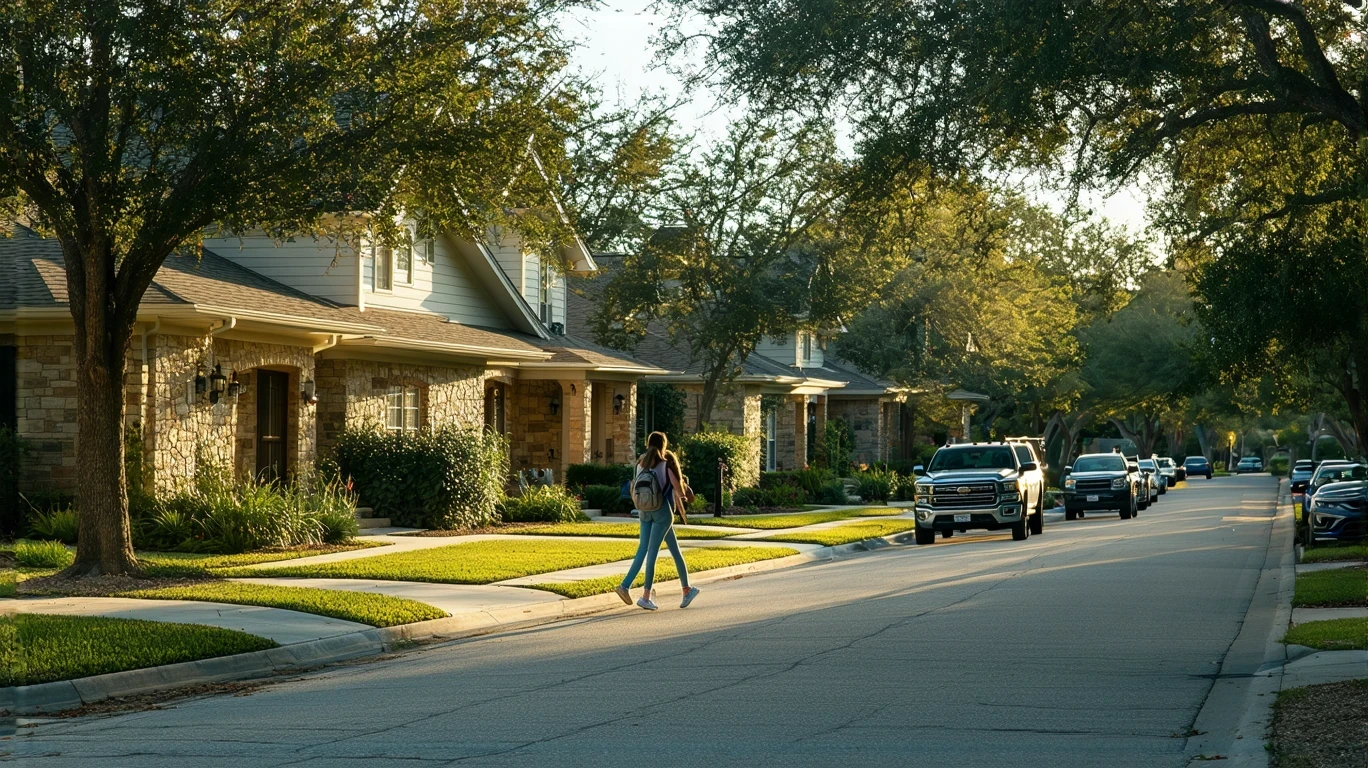
Georgetown’s transportation landscape reflects its small-town structure and low-rise, mixed-use character. Walkable pockets exist near Southwestern University’s campus, where pedestrian infrastructure density is higher and students can reach classes, coffee shops, and some errands on foot. However, this walkability doesn’t extend uniformly across the city. Corridor-clustered errands accessibility means grocery stores, restaurants, and services concentrate along specific roads, leaving gaps in between. For students living beyond the immediate campus area—whether to save on rent or due to limited housing availability—car ownership becomes a practical necessity.
Public transit options in Georgetown are limited. The city lacks rail service, and bus routes, if present, serve broader commuter needs rather than dense campus-to-neighborhood circulation. Students relying on transit will find their housing and activity options constrained. Southwestern may operate a campus shuttle for specific routes or events, but day-to-day mobility for off-campus students typically requires a personal vehicle, ride-sharing, or a bicycle. Biking infrastructure exists in pockets, and the city’s low-rise, less congested roads make cycling safer than in high-traffic urban areas—but bike lanes aren’t comprehensive, and summer heat (Georgetown experiences extended periods of triple-digit temperatures) can make biking uncomfortable for longer distances.
For students with cars, gas prices in Georgetown average $2.49 per gallon, which is relatively affordable and reduces the per-mile cost of driving. Parking near campus and in residential areas is generally available and free or low-cost, unlike denser college towns where parking scarcity drives up expenses. The tradeoff is upfront: owning a car means insurance, maintenance, and registration costs that can add $150 to $300 per month to a student budget. Ride-sharing services like Uber and Lyft operate in Georgetown, but frequent use adds up quickly in a city where distances between campus, housing, and errands are too far to walk but too short to justify high per-trip costs. The transportation decision in Georgetown isn’t about convenience—it’s about whether you’re willing to trade mobility for lower rent, or pay more to live close enough to campus that a car becomes optional.
Student Cost of Living in Georgetown
Living costs for students in Georgetown hinge on housing arrangements, transportation choices, and how often you cook versus eat out. The city’s regional price parity index of 98 means overall costs run slightly below the national average, but that modest advantage gets absorbed quickly if you’re paying for solo housing or car ownership. Students who share housing, cook most meals, and live within biking distance of campus can keep monthly expenses manageable. Those who don’t face a steeper cost structure that rivals or exceeds what they’d pay in mid-sized college towns with better transit and denser amenities.
Food costs in Georgetown reflect the city’s medium-density grocery and restaurant landscape. A week’s worth of groceries for one person—basics like bread, eggs, chicken, rice, and produce—might run $40 to $60 if you shop strategically and cook most meals. Derived estimates suggest bread costs around $1.80 per pound, eggs $2.66 per dozen, and chicken $1.98 per pound—figures that align with the city’s near-national price level. Eating out regularly, whether at campus-adjacent cafes or Georgetown’s downtown corridor, adds $8 to $15 per meal, which compounds quickly for students without dining plans. Southwestern University offers meal plans for on-campus students, and some upperclassmen maintain partial plans for convenience, but off-campus students typically self-cater to control costs.
Beyond food and housing, students face textbook costs (which vary by major and semester but often hit $300 to $500 per term), entertainment expenses, and personal care. Georgetown’s small scale limits free or low-cost entertainment options compared to larger college towns—fewer concerts, fewer late-night venues, fewer student discounts at local businesses. A movie ticket, a coffee shop study session, or a weekend outing to Austin (a 30-minute drive) all add incremental costs that require budgeting discipline. Part-time job opportunities in Georgetown are relatively strong, supported by the city’s low unemployment rate of 3.6%. Students find work in retail, food service, tutoring, and campus positions, with typical wages ranging from $10 to $15 per hour. Those earnings can offset discretionary spending or reduce loan dependency, but they rarely cover full living costs without additional financial aid or family support.
Monthly Student Budget in Georgetown
Here’s what a typical monthly student budget might look like in Georgetown, comparing shared housing (splitting a three-bedroom house with two roommates) versus solo living (renting a studio or one-bedroom apartment):
| Expense Category | Shared Housing | Solo Living |
|---|---|---|
| Rent | $500 | $1,050 |
| Utilities (electric, water, internet) | $60 | $120 |
| Groceries | $220 | $220 |
| Dining Out | $80 | $100 |
| Transportation (gas, insurance, car share) | $150 | $150 |
| Textbooks & Supplies (averaged monthly) | $65 | $65 |
| Entertainment & Social | $70 | $90 |
| Personal Care & Miscellaneous | $55 | $70 |
| Total | $1,200 | $1,865 |
Estimates based on average student spending patterns and local costs; figures are illustrative and exclude tuition, fees, or financial aid.
The $665 monthly difference between shared and solo living underscores why roommates are standard practice in Georgetown. Students living alone face a cost structure that’s difficult to sustain on part-time wages and typical financial aid packages. Those who share housing and minimize transportation costs—by living close to campus or carpooling—can keep total monthly expenses under $1,300, leaving room for occasional trips to Austin, textbook purchases, or emergency savings. Students who can’t secure affordable shared housing, or who need a car for off-campus living, should budget closer to $1,500 to $1,700 per month and plan accordingly.
Student-Friendly Amenities and Services
Southwestern University provides the core of Georgetown’s student amenities: libraries, study spaces, fitness centers, and campus organizations that anchor social and academic life. The university’s small size fosters a tight-knit community where students know their professors and peers, but it also means fewer on-campus resources than large state universities offer. Students seeking additional study spaces often turn to local coffee shops—Georgetown’s downtown corridor includes a few cafes with Wi-Fi and seating, though options are limited compared to Austin’s dense cafe culture.
Recreational opportunities in Georgetown reflect the city’s moderate green space access. Parks exist and provide space for jogging, pickup sports, or outdoor study sessions, but the density and distribution are uneven. Water features are present, adding scenic value, but purpose-built recreational facilities like climbing gyms, large sports complexes, or dedicated student recreation centers are sparse. Students interested in fitness typically rely on Southwestern’s campus gym or budget chain gyms in town. Intramural sports and student organizations provide structured social outlets, but the city’s limited family infrastructure—low school and playground density—suggests fewer youth-oriented community amenities that might otherwise serve college students as well.
Healthcare access in Georgetown is routine-local: clinics and pharmacies are present, but the city lacks a hospital within its immediate boundaries. For students, this means basic health needs—urgent care, prescriptions, routine checkups—can be handled locally, but serious medical issues may require a trip to Round Rock or Austin. Southwestern likely offers a student health center for minor concerns, and mental health resources may be available through campus counseling services, though capacity and wait times vary. Students with chronic conditions or specialized healthcare needs should confirm provider availability and insurance coverage before committing to Georgetown, as the city’s healthcare infrastructure is functional but not comprehensive.
Social Scene and Nightlife for College Students
Georgetown’s social scene revolves around Southwestern University’s campus life: student organizations, intramural sports, campus events, and the relationships students build in residence halls and classes. For students who thrive in small, close-knit communities, this structure offers meaningful connection and low-pressure social opportunities. However, the city’s off-campus nightlife and entertainment options are limited. Georgetown is not a late-night town. Bars, music venues, and age-appropriate entertainment options exist but are few, and the city’s overall scale means less diversity in social settings than students might find in Austin, San Marcos, or other Texas college towns.
Students seeking concerts, live music, diverse dining, or a more anonymous urban social experience typically drive to Austin, which sits 30 minutes south. That proximity is both an asset and a cost: Austin’s entertainment and cultural scene are accessible, but frequent trips add gas, parking, and ride-sharing expenses that compound over a semester. Georgetown’s own downtown corridor offers a few restaurants, a historic square, and occasional community events, but the energy is more family-oriented and small-town than student-dominated. Dating and social networking opportunities in Georgetown are largely campus-bound—students meet through classes, clubs, and dorm life rather than through a broader city-wide social ecosystem.
For students who value a quieter, more academically focused environment and don’t mind occasional trips to Austin for nightlife, Georgetown’s social scene is adequate. For those who want walkable bars, frequent live music, and a critical mass of other college students from multiple universities, Georgetown will feel limiting. The city’s mixed land use and walkable pockets near campus do create some spontaneous social opportunities—running into classmates at a coffee shop, walking to a friend’s house for a study session—but the overall social texture is shaped by Southwestern’s small enrollment and Georgetown’s residential, low-rise character.
Safety and Practical Considerations for Students
Georgetown’s low-rise, residential character and small-town scale generally correlate with lower crime rates and a safer overall environment than dense urban college towns. Campus safety measures at Southwestern likely include campus security, emergency call boxes, and escort services for students walking at night. Off-campus students living in neighborhoods near the university typically report feeling safe, though as in any city, awareness of surroundings and basic precautions—locking doors, securing bikes, avoiding poorly lit areas at night—remain important.
Emergency services in Georgetown are accessible, and the city’s routine-local healthcare infrastructure handles urgent care needs. However, the absence of a hospital within city limits means serious medical emergencies require transport to nearby facilities. Students with chronic health conditions, mental health needs, or disabilities should confirm that Southwestern’s campus resources and Georgetown’s local providers can meet their specific requirements. Academic support services—tutoring, writing centers, disability accommodations—are typically available through the university, though the scale and capacity reflect Southwestern’s small enrollment.
Internship and career services access in Georgetown depends heavily on Southwestern’s institutional resources and the student’s field of study. The city’s low unemployment rate and proximity to Austin create part-time job opportunities, but career-track internships, especially in specialized fields, often require commuting to Austin or leveraging university alumni networks. Students in fields like education, healthcare, or business may find local opportunities; those in tech, media, or niche industries will likely need to look beyond Georgetown’s city limits. The practical reality is that Georgetown functions as a residential college town rather than an employment hub, and students should plan their career development strategies accordingly.
How Day-to-Day Living Actually Works in Georgetown
Georgetown’s physical structure—walkable pockets near campus, corridor-clustered errands, and low-rise residential zones—shapes how students move through their days in ways that aren’t immediately obvious from rent prices or campus brochures. If you live within a half-mile of Southwestern, you can walk to class, grab coffee, and meet friends without a car. Your daily routine compresses into a small geographic footprint, and transportation costs stay minimal. But if you live farther out—whether to save $100 a month on rent or because closer housing wasn’t available—your logistics change. Grocery runs require planning. Getting to campus means driving or biking along roads without continuous bike lanes. Spontaneous social plans become harder when everyone’s scattered across town and ride-sharing costs $8 each way.
The city’s corridor-clustered errands accessibility means some blocks are dense with restaurants, grocery stores, and services, while others are purely residential. Students who land housing along those corridors gain convenience; those in the gaps between lose it. That unevenness doesn’t show up in average rent figures, but it affects how much time and money you spend on basic tasks. Georgetown’s mixed land use—residential and commercial zones interwoven—creates pockets where students can walk to a taco shop, a park, and a friend’s house in ten minutes. But those pockets are limited, and the city’s overall car-oriented infrastructure means most students eventually default to driving for anything beyond the immediate campus area.
This structure rewards students who prioritize proximity over space and who can tolerate smaller, older housing in exchange for walkability. It penalizes students who need quiet, modern apartments or who assume they can live anywhere in town and still access campus and errands easily. The difference between a $500-per-month shared house two blocks from Southwestern and a $550-per-month room a mile away isn’t just $50—it’s whether you need a car, whether you can walk home between classes, and whether your daily routine feels integrated or fragmented.
How this article was built: In addition to public economic data, this article incorporates location-based experiential signals derived from anonymized geographic patterns—such as access density, walkability, and land-use mix—to reflect how day-to-day living actually feels in Georgetown, TX.
FAQs About Student Life in Georgetown
What’s the average cost of student living in Georgetown?
Students sharing a three-bedroom house near Southwestern University typically spend $1,200 to $1,400 per month, including rent, utilities, groceries, transportation, and discretionary expenses. Solo living in a studio or one-bedroom apartment pushes monthly costs to $1,700 to $2,000. The biggest variable is housing: shared arrangements keep rent under $600 per person, while solo apartments start around $1,000. Transportation costs depend on proximity to campus—students who can walk or bike save $100 to $200 per month compared to those who need a car.
How safe is it for students to live off-campus in Georgetown?
Georgetown’s residential, low-rise character and small-town scale generally create a safer environment than dense urban college towns. Neighborhoods near Southwestern University are typically quiet and family-oriented, and students report feeling comfortable walking during the day. Standard precautions—locking doors, securing bikes, staying aware of surroundings at night—remain important. Campus security and local emergency services are accessible, though serious medical emergencies may require transport to nearby hospitals outside city limits.
Are there good part-time job opportunities for students in Georgetown?
Yes. Georgetown’s unemployment rate of 3.6% reflects a relatively strong local job market, and students find part-time work in retail, food service, tutoring, and campus positions. Typical wages range from $10 to $15 per hour. Southwestern University also offers work-study positions and on-campus employment. However, career-track internships, especially in specialized fields, often require commuting to Austin or leveraging university alumni networks, as Georgetown functions more as a residential college town than an employment hub.
What’s the social scene like for college students in Georgetown?
Georgetown’s social scene centers on Southwestern University’s campus life—student organizations, intramural sports, and campus events. Off-campus nightlife and entertainment options are limited compared to larger college towns. Students seeking concerts, diverse dining, or a more urban social experience typically drive to Austin, 30 minutes south. Georgetown’s downtown corridor offers a few restaurants and community events, but the energy is more family-oriented than student-dominated. For students who value a quieter, close-knit community, Georgetown works well. For those seeking walkable bars and a critical mass of students from multiple universities, it will feel limiting.
Making the Decision: Is Georgetown Right for Your College Years?
Georgetown delivers a specific value proposition for college students: lower costs than Austin, a tight-knit campus community at Southwestern University, and a quieter, more residential environment. Students who prioritize affordability, who thrive in small college settings, and who can secure shared housing near campus will find Georgetown manageable and, for some, appealing. The city’s below-national-average price level, low gas prices, and strong part-time job market create conditions where disciplined budgeting and shared living can keep total costs under $1,400 per month—a meaningful advantage over Austin’s student housing market.
However, Georgetown’s limitations are equally clear. Limited transit infrastructure means car ownership becomes necessary for most students living off-campus, adding $150 to $300 per month in costs. Corridor-clustered errands accessibility and uneven walkability mean housing location matters more than rent price alone. The city’s small scale and limited nightlife options mean students seeking diverse entertainment, frequent social events, or urban anonymity will feel constrained. And the city’s limited family infrastructure and routine-local healthcare access suggest fewer youth-oriented amenities and services than larger college towns provide.
The decision isn’t whether Georgetown is “good” or “bad” for students—it’s whether the city’s structure aligns with how you’ll actually live. If you can live close to campus, share housing, and accept that social life will center on Southwestern rather than a broader city scene, Georgetown offers affordability and community. If you need solo housing, frequent access to urban amenities, or car-free living, Georgetown’s cost and logistical tradeoffs will erode its advantages quickly. Visit campus, walk the neighborhoods near Southwestern, and map out your monthly budget with realistic housing and transportation assumptions before committing. The city’s appeal depends entirely on whether its specific structure fits your specific needs—and that’s a calculation only you can make.