
Can you live in Cypress without a car? For most people, the answer is no—but the fuller picture is more textured than that. Cypress sits within the Houston metro area, where sprawl, dispersed destinations, and suburban development patterns make driving the default for nearly every household task. Yet bus service does exist, some neighborhoods support walking better than others, and a small number of residents do manage to reduce car dependency for specific trips. Understanding how people actually get around here—and who benefits from the limited transit that’s available—matters if you’re deciding whether Cypress fits your daily life.
How People Get Around Cypress
Driving dominates transportation in Cypress. The city’s layout reflects decades of suburban growth: single-family neighborhoods, commercial corridors set back from residential streets, and shopping centers designed with parking lots as the primary access point. While some areas show high pedestrian-to-road ratios—meaning sidewalks and pathways exist in greater density relative to the street network—those walkable pockets serve recreational purposes more than daily errands. Parks are abundant and well-distributed, and water features add to the outdoor environment, but food and grocery establishments remain sparse. That combination means residents can walk for exercise or leisure, but they still drive to buy groceries, pick up prescriptions, or meet friends for dinner.
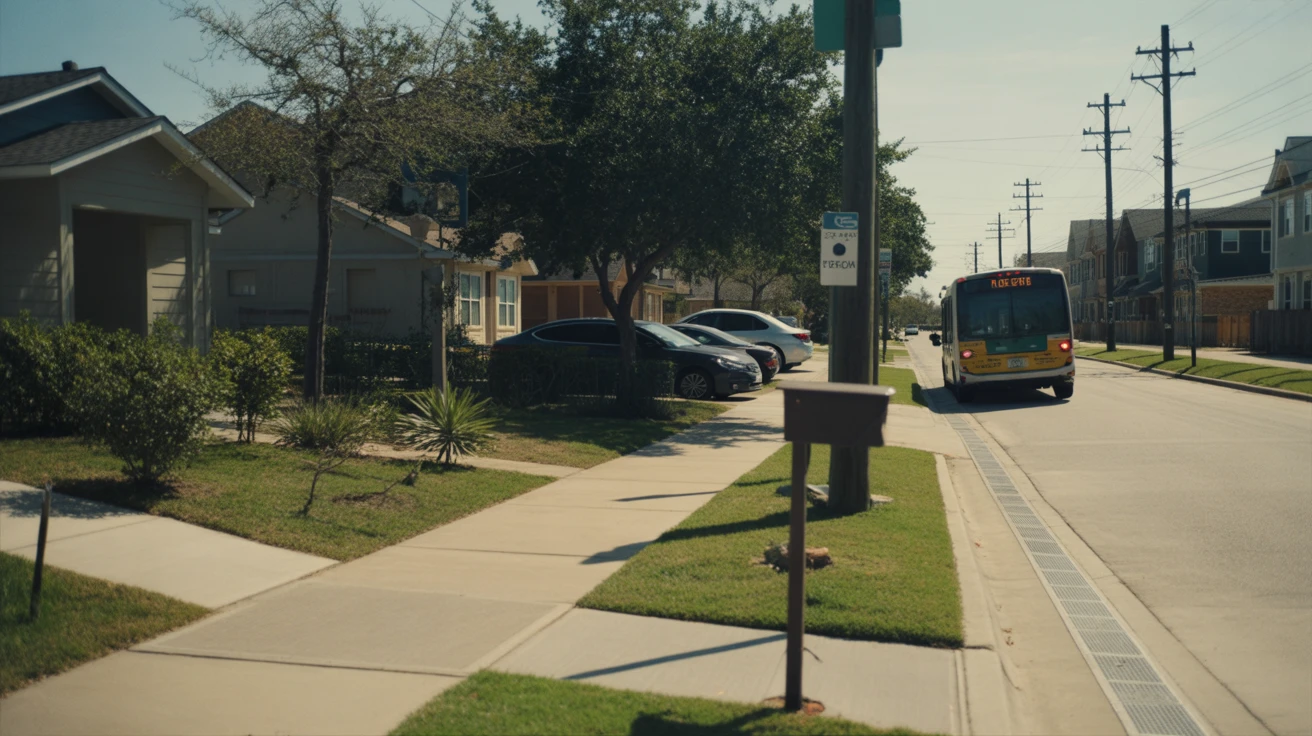
Bus service operates in Cypress, providing a supplemental option for residents whose routes align with coverage areas and schedules. Rail transit is not present. For newcomers, the most common misunderstanding is assuming that walkable streets translate to walkable errands. In Cypress, the infrastructure supports walking as an activity, not as a replacement for driving. If your daily routine requires multiple stops—dropping kids at school, commuting to work, running errands—you’ll rely on a car.
Public Transit Availability in Cypress
Public transit in Cypress often centers around bus service, which provides limited but functional coverage for specific corridors and destinations. The role transit plays here is supplemental: it works best for residents who live near stops, travel along established routes, and have schedules flexible enough to accommodate service intervals. Bus service tends to be most useful for single-destination trips—commuting to a job site, reaching a medical appointment, or accessing a regional hub—rather than multi-stop errands.
Where transit falls short is in coverage breadth and schedule density. Peripheral neighborhoods, especially those farther from commercial corridors, often lack walkable access to stops. Late-hour service is limited, and routes may not connect residential areas directly to grocery stores, schools, or healthcare facilities. For families managing complex logistics—school drop-offs, after-school pickups, grocery runs—bus service rarely provides a practical alternative to driving.
Driving & Car Dependence Reality in Cypress
Driving is necessary for daily life in Cypress, not because residents prefer it universally, but because the city’s geography and infrastructure make it the most reliable way to meet household needs. Destinations are spread across a wide area, and the sparse density of food and grocery establishments means even nearby errands often require a car. Parking is generally abundant and free, which removes one friction point common in denser urban areas, but it also reinforces car-first design.
For households, car dependence translates to flexibility and control. You can leave when you want, stop where you need, and manage multiple tasks in a single trip. But it also means every adult driver in the household typically needs a vehicle, and transportation becomes a fixed cost structure rather than a variable one. Commute flexibility exists—if your job allows remote work or flexible hours, you can avoid peak traffic—but the baseline expectation is that you’ll drive to get there.
Commuting Patterns & Daily Mobility in Cypress
Commuting in Cypress typically follows a car-based pattern, with most residents driving to work either within the Houston metro area or to nearby employment centers. The structure of daily mobility reflects the city’s role as a suburban community: people live here for space, schools, and residential character, but many work elsewhere. Single-job commutes are common, though households with multiple earners or school-age children often manage multi-stop routines that require coordination and vehicle access.
Who benefits from proximity? Residents who work locally or in nearby zones spend less time commuting and face lower exposure to traffic variability. Who absorbs commute friction? Households traveling longer distances into Houston’s core or to employment centers on the far side of the metro area face longer drives and greater exposure to congestion. The absence of rail transit means there’s no high-capacity alternative for long commutes, and bus service rarely provides a faster option than driving for most routes.
Who Transit Works For—and Who It Doesn’t
Transit works best in Cypress for residents who live near bus corridors, travel to destinations along established routes, and have schedules that align with service availability. Students commuting to nearby colleges, service workers whose job sites sit along bus lines, and households seeking to reduce second-car dependency for specific trips can find value in the existing system. The key is route alignment: if your origin and destination both fall within coverage areas, and you can tolerate longer travel times compared to driving, bus service becomes a viable option.
Transit doesn’t work well for families managing school runs, multi-stop errands, or time-sensitive logistics. It also struggles to serve residents in peripheral neighborhoods where stops are not within walking distance, and it offers limited utility for households whose work or errands fall outside bus coverage. Renters living in core areas near commercial corridors have better access than homeowners in newer subdivisions farther from main roads. The difference isn’t about income or preference—it’s about geography and infrastructure.
Transportation Tradeoffs in Cypress
The tradeoff between transit and driving in Cypress isn’t primarily about cost—it’s about predictability, control, and flexibility. Driving offers door-to-door service, the ability to manage complex trips, and immunity to schedule constraints. It also requires vehicle ownership, insurance, maintenance, and fuel, all of which become fixed household expenses. Bus service reduces those fixed costs but introduces time variability, limits destination flexibility, and requires living near coverage areas.
For households deciding where to live within Cypress, the tradeoff often comes down to proximity. Neighborhoods closer to bus stops and commercial corridors offer more options, even if driving remains dominant. Neighborhoods farther out offer more space and often newer housing, but they lock in car dependency completely. Neither choice is better in the abstract—it depends on what your household prioritizes and what daily routines you need to support.
FAQs About Transportation in Cypress (2026)
Is public transit usable for daily commuting in Cypress?
Public transit is usable for daily commuting if your route aligns with bus service coverage and your schedule accommodates service intervals. It works best for single-destination trips along established corridors. For multi-stop commutes or travel outside coverage areas, driving remains the more practical option.
Do most people in Cypress rely on a car?
Yes. The vast majority of residents rely on a car for daily errands, commuting, and household logistics. Bus service exists, but the city’s layout, dispersed destinations, and sparse density of food and grocery establishments make driving the default for most households.
Which areas of Cypress are easiest to live in without a car?
Areas near bus corridors and commercial centers offer the best access to transit and walkable amenities. Even in these areas, however, most residents still drive for groceries, errands, and multi-stop trips. Living without a car in Cypress is possible for a small number of households with specific route alignments and flexible schedules, but it’s not the norm.
How does commuting in Cypress compare to nearby cities?
Commuting in Cypress follows a similar pattern to other suburban communities in the Houston metro area: driving dominates, and transit serves as a supplemental option rather than a primary mode. Compared to cities with rail access or denser urban cores, Cypress offers less transit flexibility but more parking availability and lower congestion within the city itself.
Does Cypress have bike infrastructure?
Cypress has some cycling infrastructure, though it’s present in limited areas rather than throughout the city. Biking works best for recreation or short trips within neighborhoods, but it’s not a practical replacement for driving when managing errands, commuting, or traveling longer distances.
How Transportation Fits Into the Cost of Living in Cypress
Transportation in Cypress functions as a structural factor, not just a budget line. The need for a car—and often multiple cars per household—shapes where you can live, how you manage time, and what flexibility you retain in daily life. Driving offers control and predictability, but it also means every adult in the household typically needs a vehicle, and those vehicles require insurance, maintenance, and fuel regardless of how much you drive.
For a fuller picture of where money goes and how transportation costs interact with housing, utilities, and other expenses, the Monthly Budget article provides numeric context and household-specific breakdowns. Here, the takeaway is simpler: in Cypress, transportation is less about choosing between options and more about accepting that driving is the baseline, then deciding how much proximity and access matter to your household. Bus service exists, walkable pockets are real, and some residents do reduce car dependency for specific trips—but for most people, most of the time, getting around Cypress means driving.
How this article was built: In addition to public economic data, this article incorporates location-based experiential signals derived from anonymized geographic patterns—such as access density, walkability, and land-use mix—to reflect how day-to-day living actually feels in Cypress, TX.
—