
The morning commute in Brentwood doesn’t start at a train platform or bus shelter. It starts in a driveway. A resident backing out onto a quiet residential street, merging onto a main corridor, navigating the familiar rhythm of suburban traffic. This is how most people move through Brentwood — not by choice alone, but by design. The city’s layout, its development pattern, and its infrastructure all point toward one reality: getting around here means driving.
For newcomers weighing a move to Brentwood, understanding transportation options in Brentwood means recognizing that this is a car-first environment. Public transit plays little to no role in daily life. Walkable pockets exist, but they don’t connect to grocery stores, schools, or workplaces in a way that reduces driving dependence. The question isn’t whether you’ll need a car — it’s how much your household’s rhythm will revolve around it.
How People Get Around Brentwood
Brentwood functions as a commuter suburb south of Nashville. Its street network supports driving efficiently, with wide corridors, ample parking, and minimal congestion compared to denser urban cores. The pedestrian-to-road ratio exceeds typical suburban thresholds in certain areas, creating isolated neighborhoods where walking feels natural — tree-lined streets, sidewalks, front porches. But these walkable pockets don’t extend to daily errands. Food and grocery density fall below low thresholds, meaning even residents in the most pedestrian-friendly zones still drive for milk, prescriptions, or takeout.
Cycling infrastructure exists in limited areas, with bike-to-road ratios in the medium band. This suggests some residents can bike recreationally or for short trips, but it’s not a viable primary mode for commuting or errands. The city’s development pattern — residential subdivisions separated from commercial corridors — creates distance and discontinuity that cycling can’t easily bridge.
What newcomers often misunderstand is that Brentwood’s appeal isn’t rooted in transportation flexibility. It’s rooted in space, schools, and a quieter suburban rhythm. Mobility here is predictable and car-dependent, which works well for households that value control over their schedule and don’t mind the tradeoff of driving for nearly everything.
Public Transit Availability in Brentwood
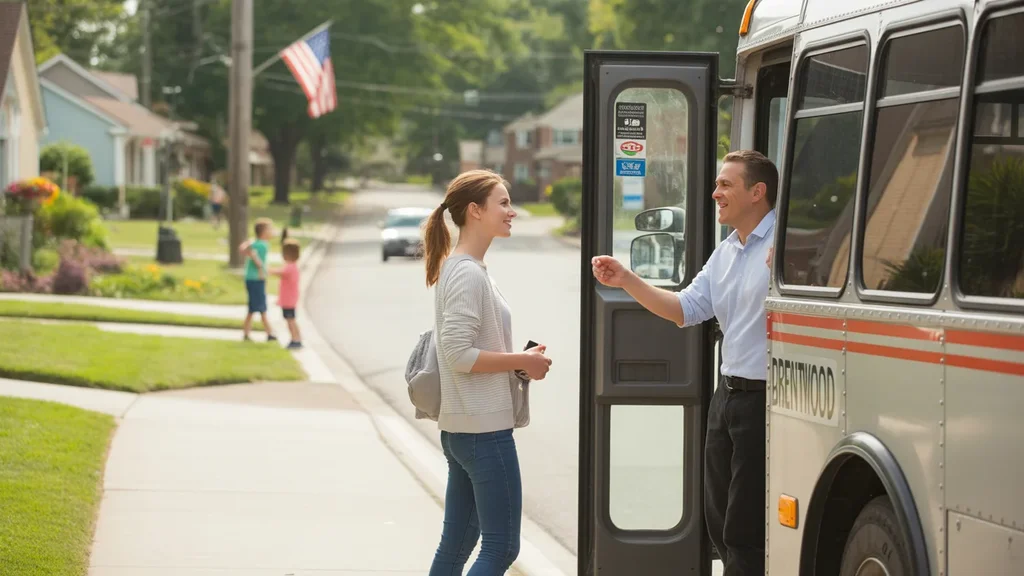
Public transit does not play a meaningful role in Brentwood’s transportation landscape. No transit signal was detected in the city’s infrastructure analysis, indicating that bus or rail service — if present at all — operates at levels too sparse or infrequent to support daily commuting or errands.
This absence isn’t an oversight. Brentwood’s density, land use, and development timeline don’t align with the conditions that make transit viable. Residential areas are spread across low-density subdivisions. Commercial activity clusters along corridors rather than concentrating in walkable nodes. The result is a geography that resists transit coverage: long distances between stops, low ridership potential, and limited service justification.
For residents accustomed to cities where transit provides a fallback or primary option, Brentwood represents a different model entirely. There’s no metro card to keep in your wallet, no route map to memorize, no schedule to check. The infrastructure simply isn’t built around that mode of movement.
Driving & Car Dependence Reality
Driving isn’t optional in Brentwood — it’s structural. Households need at least one vehicle to function, and most need two. Errands, school drop-offs, commuting, and social plans all assume car access. Parking is abundant and free in most contexts, which removes one friction point common in denser cities but reinforces the expectation that everyone arrives by car.
The city’s layout rewards driving. Roads are wide and well-maintained. Traffic moves predictably during most hours. Commute times to Nashville or nearby employment centers remain manageable for those willing to drive 20 to 30 minutes each way. But this convenience comes with a tradeoff: every trip requires a car, every household member who works or goes to school needs transportation, and flexibility depends entirely on vehicle access.
For families, this model often works well. Parents can control schedules, manage multiple stops, and avoid the coordination burden of shared transit. For single adults or renters without reliable vehicle access, Brentwood becomes logistically difficult. There’s no backup mode, no way to “make it work” without a car.
Commuting Patterns & Daily Mobility
Most Brentwood residents commute to jobs outside the city, often in Nashville or surrounding suburbs. The commute structure is typically single-destination: home to work, work to home, with occasional stops for errands or child pickup. Multi-stop commutes — common in denser cities with transit — are less frequent here because driving allows households to separate errands from the workday.
Proximity matters, but not in the way it does in transit-oriented cities. Living closer to a highway on-ramp or a main corridor reduces commute friction more than living near a commercial node. The city’s geography rewards those who can position themselves along efficient driving routes, not those seeking walkable access to daily needs.
Households with flexible work arrangements — remote days, hybrid schedules — gain the most from Brentwood’s layout. Driving dependence becomes less burdensome when commutes happen only two or three days a week. For those commuting five days, the time and fuel exposure accumulates steadily, even if traffic remains light.
Who Transit Works For — and Who It Doesn’t
Transit doesn’t work for anyone in Brentwood in a practical, day-to-day sense. The infrastructure isn’t present, and the city’s layout doesn’t support it. This creates a clear dividing line: households that can sustain car ownership fit well here; those that can’t face significant logistical barriers.
Renters without vehicles, young professionals accustomed to transit-rich cities, and older adults who no longer drive all encounter the same challenge: Brentwood’s mobility model assumes car access. There’s no workaround, no alternative network to lean on. This isn’t a judgment on the city’s design — it’s a reflection of its suburban form and the priorities embedded in that form.
Families with multiple drivers, retirees who own vehicles, and remote workers who drive infrequently all benefit from Brentwood’s car-oriented infrastructure. Parking is easy, traffic is manageable, and the predictability of driving removes the uncertainty that comes with shared transit systems.
Transportation Tradeoffs in Brentwood
Choosing Brentwood means accepting a transportation model built entirely around driving. The tradeoff is straightforward: you gain control, predictability, and space, but you lose flexibility, backup options, and the ability to function without a vehicle.
Driving offers certainty. You know when you’ll leave, when you’ll arrive, and what route you’ll take. There’s no waiting for a bus, no missed connection, no schedule to memorize. But that certainty comes with exposure: fuel costs, maintenance, insurance, and the time spent behind the wheel. For households with two working adults, that often means two cars, two sets of expenses, and two vehicles to manage.
Walkable pockets provide some relief — residents in these areas can take evening walks, let kids bike to a neighbor’s house, or enjoy a front-porch lifestyle. But these pockets don’t reduce driving dependence for errands or commuting. They add quality of life without changing the fundamental transportation structure.
The question isn’t whether Brentwood’s model is better or worse than a transit-oriented city. It’s whether this model fits your household’s rhythm, resources, and expectations. If car ownership feels like a given, Brentwood works. If it feels like a burden, the city’s layout will amplify that burden daily.
FAQs About Transportation in Brentwood (2026)
Is public transit usable for daily commuting in Brentwood?
No. Public transit infrastructure in Brentwood is minimal to non-existent. The city’s layout, density, and development pattern don’t support viable bus or rail service for daily commuting or errands. Residents rely on personal vehicles for nearly all transportation needs.
Do most people in Brentwood rely on a car?
Yes. Driving is the dominant and necessary mode of transportation in Brentwood. The city’s infrastructure, land use, and errands accessibility all assume car access. Households without vehicles face significant logistical challenges in managing daily life here.
Which areas of Brentwood are easiest to live in without a car?
No area of Brentwood functions well without a car. While some neighborhoods feature higher pedestrian infrastructure and walkable street design, grocery stores, medical facilities, and employment centers remain car-dependent. Walkability exists for recreation, not for reducing driving dependence.
How does commuting in Brentwood compare to nearby cities?
Brentwood offers predictable, low-congestion driving commutes compared to denser parts of Nashville. However, it lacks the transit options available in the urban core. Residents trade transit flexibility for driving ease, which works well for car-owning households but limits options for those without vehicles.
Can you bike for errands or commuting in Brentwood?
Cycling infrastructure exists in limited areas, but it’s not practical for most errands or commuting. Distances between residential areas and commercial corridors, combined with sparse grocery and food access, make biking a recreational option rather than a functional transportation mode for daily needs.
How Transportation Fits Into the Cost of Living in Brentwood
Transportation in Brentwood isn’t just a line item — it’s a structural factor that shapes where money goes and how households organize their lives. Car dependence means every adult in the household likely needs a vehicle, which multiplies insurance, fuel, and maintenance exposure. It also means housing location matters less for walkability and more for driving efficiency: proximity to highways, main corridors, and parking availability.
For families, this model often simplifies logistics. Parents control schedules, manage multiple stops, and avoid the coordination burden of shared transit. For single adults, renters, or older residents who no longer drive, the lack of alternatives creates friction that affects daily routines and limits housing flexibility.
Understanding getting around Brentwood means recognizing that mobility here is predictable, car-first, and built for households that value control and space over transportation variety. If that fits your expectations, the city’s infrastructure will feel intuitive. If it doesn’t, the limitations will surface quickly.
How this article was built: In addition to public economic data, this article incorporates location-based experiential signals derived from anonymized geographic patterns—such as access density, walkability, and land-use mix—to reflect how day-to-day living actually feels in Brentwood, TN.