
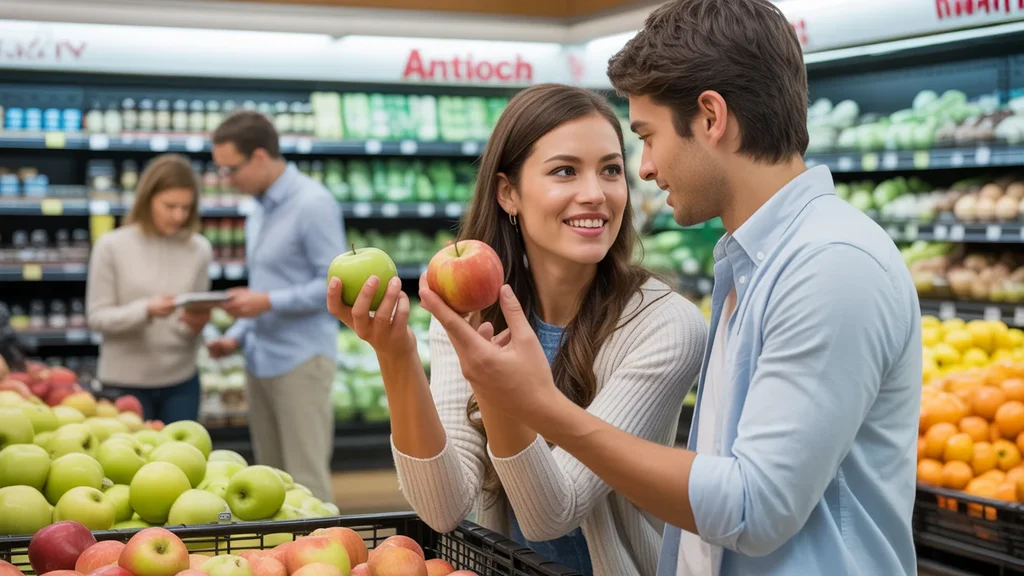
How Grocery Costs Feel in Antioch
Grocery prices in Antioch sit slightly below the national baseline, with a regional price parity index of 97—a modest but real discount that shows up across staple categories. For households moving from higher-cost metros, that difference registers as breathing room at checkout. For those arriving from lower-cost rural areas, Antioch’s prices may feel closer to neutral. The experience depends less on a single average price and more on how household size, store choice, and shopping habits interact with the local grocery landscape.
Singles and couples without children tend to notice grocery costs most acutely, not because prices are high, but because smaller households face tighter waste margins and fewer opportunities to leverage bulk pricing. A couple buying for two can take advantage of planning and volume without the risk of spoilage that singles face. Families with children, meanwhile, encounter the highest absolute spending but often find that Antioch’s grocery infrastructure—particularly its strong density of grocery establishments—supports the kind of strategic shopping that keeps per-person costs manageable. The pressure isn’t uniform; it’s shaped by how much you buy, where you shop, and how much flexibility you have to move between store tiers.
What makes Antioch distinct isn’t just the modest regional discount—it’s the way what a budget has to handle in Antioch is influenced by the structure of access itself. Grocery options here cluster along commercial corridors rather than spreading evenly across neighborhoods. That means some households enjoy walkable access to multiple tiers, while others face a choice: drive to save, or pay a convenience premium closer to home. For families managing tight margins, that geography matters as much as the prices themselves.
Grocery Price Signals (Illustrative)
These prices illustrate how staple items tend to compare locally—not a full shopping list. They reflect the regional price adjustment captured in the RPP index and provide a sense of relative positioning, not checkout-level accuracy. Prices vary by store tier, season, and promotion, so treat these as directional anchors rather than guarantees.
| Item | Illustrative Price |
|---|---|
| Bread (per pound) | $1.74/lb |
| Cheese (per pound) | $4.58/lb |
| Chicken (per pound) | $1.98/lb |
| Eggs (per dozen) | $2.77/dozen |
| Ground beef (per pound) | $6.34/lb |
| Milk (per half-gallon) | $3.88/half-gallon |
| Rice (per pound) | $1.03/lb |
Protein and dairy represent the largest share of grocery pressure for most households. Ground beef and cheese sit at the higher end of the staple spectrum, while chicken and eggs offer more affordable volume. Rice and bread anchor the budget-friendly end, providing calorie density at low cost. For families stretching dollars, the gap between high and low tiers widens most dramatically in the protein and dairy aisles, where brand and store choice can shift weekly spending noticeably without changing the cart’s contents.
Store Choice & Price Sensitivity
Grocery price pressure in Antioch varies more by store tier than by any single “average” experience. The city’s grocery landscape divides into three functional tiers: discount chains that prioritize price over selection, mid-tier grocers that balance convenience and cost, and premium stores that emphasize quality, prepared foods, and specialty items. For households managing tight budgets, the discount tier offers the clearest path to lower spending, but it requires planning, flexibility on brands, and often a willingness to drive. Mid-tier stores occupy the middle ground—close enough to home for many, with enough variety to avoid multiple stops, but without the rock-bottom pricing of discount chains. Premium stores serve households with more income elasticity, where time savings and product quality justify higher per-item costs.
What makes this tier structure matter in Antioch is the way grocery establishments cluster along commercial corridors rather than spreading evenly. Some neighborhoods enjoy proximity to multiple tiers, allowing households to mix and match based on the week’s needs. Others sit farther from discount options, meaning the choice to save money requires a deliberate trip. For families with young children or single-income households, that travel friction can tip the balance toward convenience over cost, even when the household would prefer to stretch dollars further. The result is that two families with identical incomes and household sizes can experience meaningfully different grocery pressure depending on where they live and how much time they can dedicate to shopping strategy.
Chain grocers dominate the landscape, offering predictable pricing and loyalty programs that reward volume. Local and independent grocers exist but occupy a smaller share of the market, often positioning themselves as premium or specialty alternatives rather than price competitors. For households prioritizing local sourcing or unique product selection, those independents provide value beyond price—but they rarely compete on cost with the discount tier. The side-by-side reality is this: chain stores set the baseline for affordability and access, while local grocers serve households willing to pay more for differentiation. Both have a role, but for most households managing grocery costs, the chain tier is where the budget gets built.
What Drives Grocery Pressure Here
Income plays a quiet but persistent role in how grocery costs feel. Households with higher earnings experience food spending as a smaller share of total budget, allowing them to absorb price swings, prioritize convenience, or shop premium tiers without recalculating. For households closer to the median or below, grocery spending competes directly with housing, utilities, and transportation—categories that don’t flex. When protein prices spike or a household grows, the grocery line item tightens before others do. That income interaction doesn’t change the prices on the shelf, but it changes how much margin a household has to respond when prices shift or needs increase.
Household size amplifies grocery pressure in both directions. Singles face the highest per-person costs because package sizes, waste risk, and the fixed cost of a shopping trip don’t scale down efficiently. Couples gain efficiency without the complexity of feeding children. Families with kids encounter the highest absolute spending, but per-person costs often drop if the household can plan effectively and leverage bulk pricing. The challenge for larger households isn’t the unit price—it’s the volume and the relentlessness. A family of four buying chicken, milk, and eggs at favorable prices still spends more in a week than a single person buying premium equivalents. The pressure isn’t always about price; sometimes it’s about the sheer frequency and scale of replenishment.
Regional distribution patterns shape access more than prices. Antioch’s grocery density is high, but the concentration along corridors rather than even distribution means proximity varies widely by neighborhood. Households near commercial nodes enjoy choice and competition; those farther out face longer drives or fewer tier options. Seasonal variability exists but operates more subtly here than in regions with extreme agricultural seasonality. Prices on fresh produce shift with national supply patterns, but staples like dairy, protein, and grains hold steadier. The biggest seasonal pressure comes not from price swings but from holiday volume—times when households buy more, host more, and feel the cumulative weight of a grocery budget stretched across weeks of higher throughput.
Practical Ways People Manage Grocery Costs
Households managing grocery costs in Antioch rely on behavioral strategies that reduce waste, maximize value, and smooth spending over time. Meal planning stands out as the most effective lever—not because it’s complicated, but because it aligns purchasing with actual consumption. Planning a week’s meals before shopping reduces impulse buys, prevents duplicate purchases, and ensures that perishable items get used before spoiling. For families, this also reduces the cognitive load of daily “what’s for dinner” decisions, which often lead to convenience purchases or takeout when no clear plan exists.
Shopping a single store tier consistently builds familiarity with pricing patterns and reduces the temptation to overbuy. Households that rotate between stores or chase sales across multiple locations often spend more time and fuel than they save. Loyalty programs and store apps provide modest discounts, but the real value comes from understanding a store’s pricing rhythm—knowing when staples go on sale and stocking up during those windows. Buying in bulk works well for non-perishables and household staples, but only if storage space and upfront cash flow allow it. Freezing proteins and batch-cooking meals extends the value of bulk purchases and reduces the per-meal cost of cooking at home.
Reducing food waste has a direct impact on effective grocery costs. Households that track what gets thrown away often discover they’re discarding 10–15% of what they buy—a hidden cost that doesn’t show up at checkout but erodes the value of every dollar spent. Using leftovers intentionally, storing produce properly, and buying smaller quantities of high-waste items all contribute to keeping more of what’s purchased in circulation. The goal isn’t perfection; it’s reducing the frequency of “we bought it but didn’t use it” moments that quietly inflate the true cost of feeding a household.
Groceries vs Eating Out (Directional)
The tradeoff between cooking at home and eating out isn’t just financial—it’s a negotiation between time, energy, and convenience. Cooking at home consistently costs less per meal than restaurant or takeout equivalents, but the gap narrows when factoring in the time required to plan, shop, cook, and clean. For households with two working adults or single parents managing tight schedules, the convenience of prepared food sometimes justifies the premium, especially on high-stress days when cooking feels like one task too many.
Antioch’s food landscape supports both modes. Grocery density is high, and the discount tier makes home cooking affordable for households willing to plan. At the same time, the corridor-clustered structure of commercial development means that many of the same trips that take households to grocery stores also pass fast-casual and takeout options. The proximity creates friction in the opposite direction: it’s easy to stop for food on the way home, especially when the household is tired and the fridge feels empty. The financial impact accumulates slowly—one or two takeout meals a week doesn’t break a budget, but it does shift the average cost per meal upward in ways that compound over months.
For households managing grocery costs intentionally, the strategy isn’t to eliminate eating out entirely—it’s to treat it as a planned expense rather than a default response to decision fatigue. Cooking larger batches on weekends, keeping a rotation of simple fallback meals, and budgeting for occasional convenience all help maintain the lower per-meal cost of groceries without creating unsustainable pressure. The goal is control, not perfection.
FAQs About Grocery Costs in Antioch (2026)
Is it cheaper to shop in bulk in Antioch? Bulk purchasing reduces per-unit costs on non-perishables and frequently used staples, but only if you have the upfront cash flow and storage space to make it practical. For smaller households, bulk buying can increase waste if items spoil before use.
Which stores in Antioch are best for low prices? Discount-tier chains offer the most consistent savings, especially on staples like protein, dairy, and pantry goods. Mid-tier grocers balance cost and convenience, while premium stores prioritize quality and selection over price.
How much more do organic items cost in Antioch? Organic products typically carry a premium, with the gap widest in produce and dairy. The exact difference varies by store tier and season, but households prioritizing organic should expect to allocate a larger share of their grocery budget to those categories.
How do grocery costs for two adults in Antioch tend to compare to nearby cities? Antioch’s regional price parity of 97 suggests a modest discount relative to the national baseline, which often translates to slightly lower costs than higher-cost metros in the region. The difference is real but not dramatic—store choice and shopping habits matter more than location alone.
How do households in Antioch think about grocery spending when cooking at home? Most households treat grocery spending as a controllable line item, using meal planning, strategic store choice, and waste reduction to keep costs predictable. The focus is less on hitting a specific dollar target and more on maintaining consistency and avoiding the expense creep that comes from frequent takeout or impulse purchases.
Does Antioch’s grocery landscape favor families or singles? Families benefit from higher grocery density and the ability to leverage bulk pricing without excessive waste risk. Singles face tighter margins due to package sizes and waste exposure, but the variety of store tiers provides options for those willing to shop strategically.
How does proximity to grocery stores affect costs in Antioch? Households near commercial corridors enjoy access to multiple store tiers, which supports price comparison and strategic shopping. Those farther from discount options may face a choice between driving to save or paying a convenience premium closer to home, which can shift effective costs even when shelf prices are identical.
How Groceries Fit Into the Cost of Living in Antioch
Grocery spending sits in the middle tier of household costs—less dominant than housing, more controllable than utilities, and more frequent than transportation. It’s a category where behavior and strategy create meaningful variation, even when income and household size are identical. For most households, groceries represent one of the few line items where intentional effort translates directly into lower spending without sacrificing quality of life. That makes it a natural place to focus when budgets feel tight, but it also means that grocery costs rarely drive the overall affordability picture on their own.
What matters more is how grocery spending interacts with the larger cost structure. Households spending a smaller share on housing have more room to absorb grocery price swings or prioritize convenience. Those stretched thin by rent or mortgage payments feel grocery pressure more acutely because there’s less slack in the budget to absorb variation. The same dynamic applies to transportation—households that drive frequently for work or errands face higher fuel and maintenance costs, which leaves less margin for food spending. Understanding where grocery costs fit requires looking at the full picture of where money goes each month, not just the grocery line in isolation.
For a complete view of how grocery spending fits into the broader monthly cost structure—including housing, utilities, transportation, and other essentials—see what a budget has to handle in Antioch. That breakdown provides the context needed to assess whether grocery costs are the primary pressure point or just one piece of a larger financial puzzle. The goal isn’t to optimize groceries in isolation—it’s to understand how food spending fits into the household’s overall financial position and where the most effective adjustments can be made.
How this article was built: In addition to public economic data, this article incorporates location-based experiential signals derived from anonymized geographic patterns—such as access density, walkability, and land-use mix—to reflect how day-to-day living actually feels in Antioch, TN.