
Hillsboro sits at the western edge of the Portland metro area, home to major employers and residential neighborhoods that stretch from older, grid-patterned cores to newer suburban subdivisions. How you get around here depends heavily on where you live and where you need to go. Transportation options in Hillsboro reflect a city caught between transit-oriented ambitions and the practical realities of a sprawling layout. Rail service exists, bike infrastructure is more developed than many suburban peers, and walkable pockets have emerged—but most households still depend on a car for the majority of their daily needs.
Newcomers often assume Hillsboro functions like inner Portland, where transit can replace car ownership. That’s rarely the case. While some residents successfully build car-light or car-free lives, they tend to cluster near specific corridors and make deliberate tradeoffs around job location, errands, and schedule flexibility. For everyone else, driving remains the default, and the city’s layout reinforces that dependence.
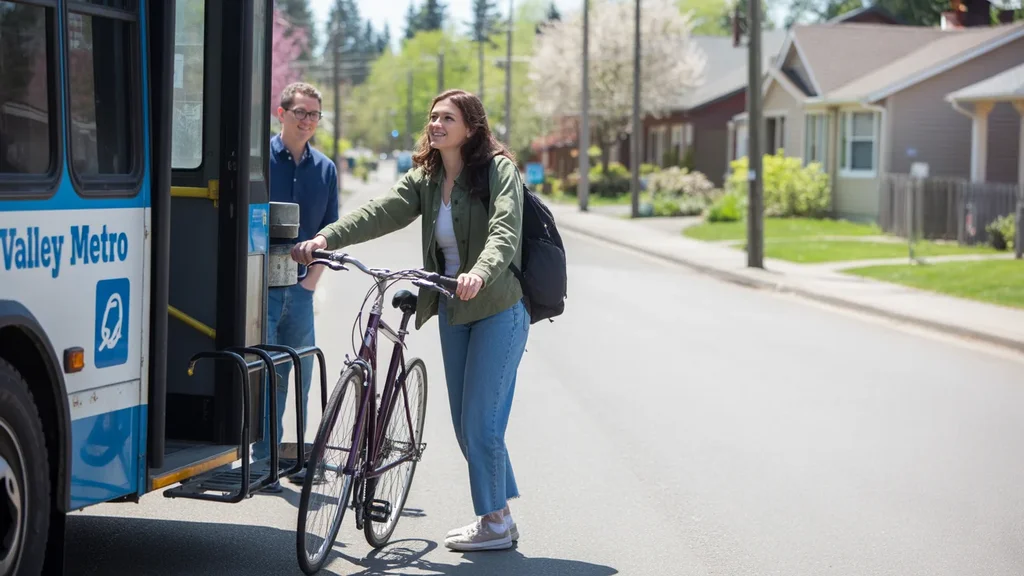
How People Get Around Hillsboro
The dominant pattern in Hillsboro is car-first mobility with selective transit use. Most residents drive for work, errands, and household logistics. According to available data, only 6.8% of workers in Hillsboro work from home, and 30.9% face long commutes—suggesting that many people travel significant distances regularly, often to job centers that aren’t easily reached by transit.
That said, Hillsboro has invested in infrastructure that supports alternatives. The pedestrian-to-road ratio exceeds high thresholds, meaning sidewalks, crosswalks, and pedestrian pathways are more prevalent here than in many comparable suburbs. Bike infrastructure is similarly notable, with bike-to-road ratios that signal a real commitment to cycling as a viable option. These investments create pockets—particularly near downtown Hillsboro and along certain corridors—where walking and biking genuinely work for short trips.
But infrastructure alone doesn’t eliminate car dependence. Food and grocery density falls into a medium band, clustered along commercial corridors rather than distributed evenly across neighborhoods. That clustering means errands often require intentional trips, and for households managing multiple stops—daycare, groceries, appointments—driving becomes the only practical choice.
Public Transit Availability in Hillsboro
Public transit in Hillsboro often centers around systems such as TriMet, which operates the MAX Blue Line light rail connecting Hillsboro to downtown Portland and Gresham. Rail service is present and provides a real alternative for commuters whose jobs align with the MAX corridor. For those living near stations and working in downtown Portland or other rail-accessible areas, transit can replace daily driving entirely.
Bus service supplements rail coverage, extending reach into neighborhoods not served by light rail. However, coverage varies significantly by area. Residents in older, denser parts of Hillsboro near the city center tend to have more frequent and useful transit options. Those in newer subdivisions on the city’s edges often find that bus routes run infrequently or require long walks to the nearest stop, making transit impractical for time-sensitive trips.
Transit works best for predictable, single-destination commutes during peak hours. It falls short for errands, off-peak travel, and trips that require multiple stops. Families managing school drop-offs, grocery runs, and evening activities rarely find transit flexible enough to replace a car. Late-night and weekend service is limited, which narrows the window of usability for shift workers and social trips.
Driving & Car Dependence Reality
For most Hillsboro households, driving isn’t optional—it’s structural. The city’s layout, with residential areas separated from commercial corridors and employment centers, makes car ownership the path of least resistance. Parking is generally abundant and free in most areas, which removes one of the friction points that might otherwise discourage driving.
Commute times average 23 minutes, which is manageable but reflects the reality that many residents work outside Hillsboro or in parts of the metro area not well-served by transit. Gas prices in the area stand at $3.92 per gallon, a cost that drivers absorb regularly but one that doesn’t typically shift behavior in a region where alternatives are limited.
Car dependence also shapes housing decisions. Households that prioritize walkability or transit access pay a premium to live near MAX stations or in denser, older neighborhoods. Those willing to drive gain access to larger homes and newer developments at lower price points, but they trade convenience for space and absorb the time and cost of driving as a fixed part of daily life.
Commuting Patterns & Daily Mobility
Commuting in Hillsboro often involves a mix of local trips and longer journeys into Portland or other parts of Washington County. The 30.9% long-commute rate suggests that a significant share of workers travel well beyond the immediate area, likely to job centers in Beaverton, downtown Portland, or even across the Columbia River.
Single-job commuters with predictable schedules and destinations along the MAX line benefit most from transit. They can avoid traffic, parking costs, and the daily friction of driving. Multi-stop commuters—those who need to drop off children, run errands, or work irregular hours—find transit far less viable and default to driving.
Proximity matters more than infrastructure. A household living within walking distance of a MAX station and working downtown Portland experiences Hillsboro very differently than a household in a subdivision three miles from the nearest transit stop. The former can structure life around transit; the latter cannot, regardless of how good the system is in theory.
Who Transit Works For—and Who It Doesn’t
Transit in Hillsboro works best for single adults or couples without children, living near rail stations, working in transit-accessible job centers, and comfortable with limited schedule flexibility. These households can genuinely reduce or eliminate car ownership, saving on insurance, maintenance, and parking while accepting longer trip times and less spontaneity.
Transit works less well for families with young children, households managing complex logistics, and anyone whose job or daily routine requires travel outside the MAX corridor. Parents juggling school schedules, extracurriculars, and grocery runs find that transit adds friction rather than removing it. Shift workers and those with evening or weekend commitments face limited service and long waits.
Renters in older, denser neighborhoods near downtown Hillsboro have the best shot at car-light living. Homeowners in newer subdivisions on the city’s periphery rarely find transit practical, even if they’re ideologically inclined to use it. Geography and density determine fit more than personal preference.
Transportation Tradeoffs in Hillsboro
Choosing between transit and driving in Hillsboro means weighing predictability against flexibility. Transit offers fixed costs, no parking hassles, and immunity to traffic—but it also means longer trip times, limited coverage, and schedule dependence. Driving offers control, convenience, and the ability to handle complex logistics—but it comes with variable costs, traffic exposure, and the ongoing burden of vehicle ownership.
For households near MAX stations with compatible work locations, transit can replace most driving. For everyone else, the question isn’t whether to own a car, but how much to drive it. Some residents use transit for commuting and drive for errands; others drive daily and view transit as an occasional backup.
The tradeoff isn’t financial in isolation—it’s about time, control, and household complexity. A 30-minute drive might take 50 minutes by transit, but it’s also predictable and doesn’t require parking downtown. A car offers spontaneity but demands maintenance, insurance, and fuel. Neither option is universally better; fit depends on where you live, where you work, and how much friction you’re willing to absorb.
FAQs About Transportation in Hillsboro (2026)
Is public transit usable for daily commuting in Hillsboro?
Yes, if you live near a MAX station and work along the light rail corridor. Rail service connects Hillsboro to downtown Portland and other transit-accessible job centers, making car-free commuting viable for households with compatible geography. Outside those corridors, transit becomes less practical, and most residents default to driving.
Do most people in Hillsboro rely on a car?
Yes. While transit infrastructure exists and some residents use it regularly, the majority of Hillsboro households depend on cars for daily life. The city’s layout, errand clustering, and job distribution make driving the default for most families, especially those with children or complex schedules.
Which areas of Hillsboro are easiest to live in without a car?
Neighborhoods near downtown Hillsboro and within walking distance of MAX stations offer the best chance of car-light or car-free living. These areas combine transit access, walkable errands, and denser development. Newer subdivisions on the city’s edges require car ownership for practical daily mobility.
How does commuting in Hillsboro compare to nearby cities?
Hillsboro’s average commute time of 23 minutes is moderate for the Portland metro area, but the 30.9% long-commute rate suggests many residents travel significant distances regularly. Compared to inner Portland, Hillsboro offers less transit coverage and more car dependence. Compared to outer suburbs, it offers better bike infrastructure and rail access.
Can you get by with just a bike in Hillsboro?
In limited circumstances, yes. Hillsboro’s bike infrastructure is more developed than many suburban peers, with bike-to-road ratios that exceed high thresholds. Households living near employment, errands, and services can build bike-centric routines, especially in warmer months. But most residents find bikes useful for recreation or short trips rather than as a car replacement.
How Transportation Fits Into the Cost of Living in Hillsboro
Transportation isn’t just a line item—it’s a structural factor that shapes where you can live, how much time you spend traveling, and what kinds of tradeoffs you’re forced to make. Households that prioritize transit access often pay more for housing near MAX stations but save on car ownership and driving costs. Those who choose affordability in peripheral neighborhoods absorb longer commutes and higher transportation exposure.
The real cost of transportation in Hillsboro isn’t just fuel and fares—it’s time, flexibility, and the daily friction of getting where you need to go. Some households find that monthly expenses shift dramatically based on proximity to transit and walkable errands. Others discover that car dependence is non-negotiable, regardless of preference.
If you’re evaluating whether Hillsboro’s transportation reality fits your life, focus on where you’ll work, where you’ll live, and how much complexity your household manages daily. Transit works for some; driving works for most. Neither option is wrong, but the fit matters more than the infrastructure.
How this article was built: In addition to public economic data, this article incorporates location-based experiential signals derived from anonymized geographic patterns—such as access density, walkability, and land-use mix—to reflect how day-to-day living actually feels in Hillsboro, OR.